

- BGG rank
- BGG #13,103
- BGG rating
- 7.2
NATO, Nukes & Nazis
- 2 players
- 180 min
- Complexity 3.8/5
- 1990
2014
Rules assistance for Angola: Cold War Struggle in Africa
Plain-language explanations of turns, card effects and disputed situations, with official source references and saved question history.
What would you like to know?
Answers come from the official rulebook, with the page to check.
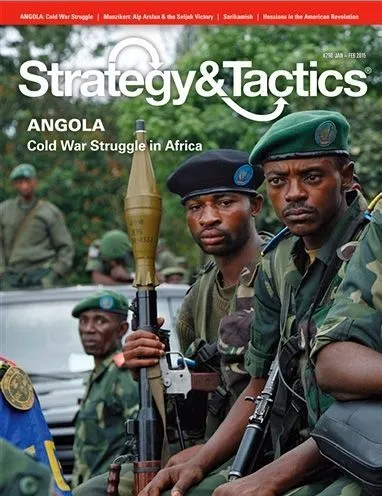
Angola: Cold War Struggle in Africa is a board game released in 2014 for 1–2 players. It was designed by Joseph Miranda and its main mechanics are Dice Rolling and Hexagon Grid.





Angola is a simulation of the 1987-88 campaign which was the culmination of the civil war in that country during the height of the Cold War. This campaign saw major offensives by both sides, with considerable intervention by the armed forces of Cuba and South Africa. Among other things, Angola saw some of the biggest armored actions of the Cold War. The game is operational level. Each player commands the forces of several different factions, each faction representing a major entity in this particular conflict whose goal was to gain control of as much of Angola as possible while inflicting decisive losses on the enemy. Command control is a critical factor, and the game uses a variant of the “Boots” system to model this. Each game turn represents about one month of operations. The map features all of Angola and the adjoining border regions of Southwest Africa and Zaire. The map scale is approximately 31 miles (50 kilometers) across each hexagon; each brigade or regiment represents from about 1,000 to 3,000 men, depending on the army. A battalion is 300-900 men, whereas a cadre represents small teams of soldiers. Components: One 22" x 34" map & 228 counters
Angola: Cold War Struggle in Africa supports 1–2 players according to the catalogue. This range comes from the publisher’s listed player count, so the game can be set up for any group size within it. Some setups, rules and scoring details may still vary by player count, so check your edition’s rulebook for the exact configuration.
Angola: Cold War Struggle in Africa has a complexity rating of 3.3 out of 5 from BoardGameGeek players, which makes it a medium-weight game. The rating reflects how much rules knowledge, planning and decision-making a typical game demands. Expect a longer first teach for heavier games, and use a preparation guide before game night.
Angola: Cold War Struggle in Africa belongs to these categories: Wargame and Modern Warfare. Its main mechanics are Dice Rolling and Hexagon Grid. Categories describe the theme and setting of a game, while mechanics describe what players actually do on their turns. Each mechanic links to a catalogue hub with similar games, which helps when you want something comparable.
The credited designers of Angola: Cold War Struggle in Africa are: Joseph Miranda. These credits come from the published game data and name the people responsible for the game’s design, not its illustrators or publishers. Designer pages on MeepleRules collect other titles by the same designers, which helps when you enjoy a game and want to find similar ones.
The catalogue lists Angola: Cold War Struggle in Africa as a base game. It can be played on its own with the components in the box and does not require any other title. Expansions, if any exist, add new content or rules on top of it and are listed separately in the catalogue with a link back to this base game.