- BGG rating
- 9.2
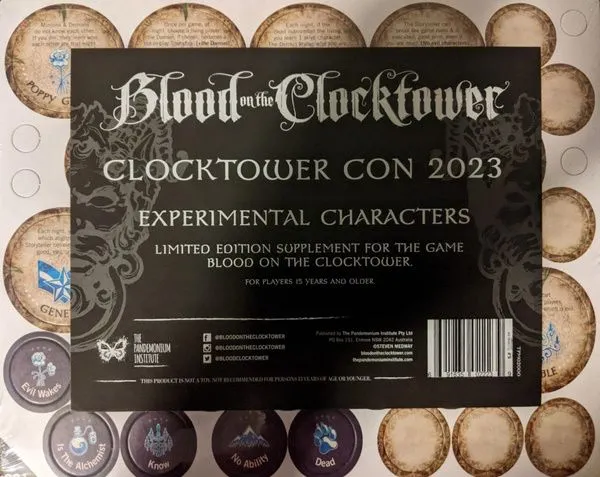
Blood on the Clocktower: Clocktower Con 2023 Experimental Characters
5–20 players30–120 min2023

2022
Rules assistance for Blood on the Clocktower
Plain-language explanations of turns, card effects and disputed situations, with official source references and saved question history.
What would you like to know?
Answers come from the official rulebook, with the page to check.
Good wins when the Demon dies; evil wins when only two players remain alive, excluding Travellers. If both occur together, good wins.
About 10 min · 8 steps
Step 1 of 8
Yes. You may talk, lie, share information, remain silent, or talk privately.
Yes, but each dead player can vote only once more in the game.
At least half the living players’ votes, and more than every other nominee.
No. There is at most one execution per day, and a day may end without one.
No. You may still talk and win or lose with your team, but you lose your ability and have one vote left.
Good normally wins when the Demon dies. Some abilities can keep the game going.
Evil normally wins when only two players remain alive; Travellers do not count toward that condition.
Blood on the Clocktower is a board game released in 2022 for 5–21 players, 30–120 minutes per game, and ages 15 and up. It was designed by Steven Medway and its main mechanics are Variable Player Powers, Deduction, and Team-Based Game. MeepleRules offers a rules assistant for Blood on the Clocktower that explains turns, card effects and disputed situations in plain language.
5–10 players30 min2012
5–10 players45 min2016

4–12 players20 min2014
5–11 players45–90 min2022

5–10 players30 min2009
3–10 players10 min2014

4–8 players20–40 min2021
8–24 players60 min1986
6–28 players10–40 min2025
4–10 players30 min2021

2–9 players5–15 min2025
5–7 players120 min2025

5–68 players30–90 min2008

5–30 players30–90 min2014

5–75 players30 min2014
In the sleepy town of Ravenswood Bluff, a demon walks amongst you. During a hellish thunderstorm, on the stroke of midnight, there echoes a bone-chilling scream. The townsfolk rush to investigate and find the town storyteller murdered, their body impaled on the hands of the clocktower, blood dripping onto the cobblestones below. A Demon is on the loose, murdering by night and disguised in human form by day. Some have scraps of information. Others have abilities that fight the evil or protect the innocent. But the Demon and its evil minions are spreading lies to confuse and breed suspicion. Will the good townsfolk put the puzzle together in time to execute the true demon and save themselves? Or will evil overrun this once peaceful town? Blood on the Clocktower is a bluffing game with players on opposing teams of Good and Evil, overseen by a Storyteller player who conducts the action and makes crucial decisions. The goal of the game is to successfully deduce and execute the demons before they outnumber the townfolk. During a 'day' phase players socialize openly and whisper privately to trade knowledge or spread lies, culminating in a player's execution if a majority suspects them of being Evil. During a 'night' time, players close their eyes and are woken one at a time by the Storyteller to gather information, spread mischief, or kill. The Storyteller uses the game's intricate playing pieces to guide each game, leaving others free to play without a table or board. Players stay in the thick of the action to the very end even if their characters are killed, haunting Ravenswood Bluff as ghosts trying to win from beyond the grave. If you arrive late to a game, you can enter after it's started as a powerful Traveller character with unusual talents and questionable allegiances. Each character comes with their own special ability and no two players in a game are ever the same character.
Use the rules assistant for Blood on the Clocktower to describe a turn, card effect or disputed situation. Get a plain-language explanation with official source references, then return to the question in your saved history. Select your edition when available so the sources match your game.
Ask about the rulesBlood on the Clocktower supports 5–21 players according to the catalogue. This range comes from the publisher’s listed player count, so the game can be set up for any group size within it. Some setups, rules and scoring details may still vary by player count, so check your edition’s rulebook for the exact configuration.
The listed playing time for Blood on the Clocktower is 30–120 minutes. This is the publisher’s estimate for a full game. The actual duration depends on the group, the player count and familiarity with the rules: first sessions usually run longer, while experienced groups often finish faster. Setup and teaching time are not included in this estimate.
The catalogue lists Blood on the Clocktower for ages 15 and up. This is the publisher’s recommendation and reflects reading demands, rule complexity and small components rather than theme alone. Younger players can often join with help from an adult, so check the age guidance on your edition and consider your group’s experience with board games.
Blood on the Clocktower has a complexity rating of 3.0 out of 5 from BoardGameGeek players, which makes it a medium-weight game. The rating reflects how much rules knowledge, planning and decision-making a typical game demands. Expect a longer first teach for heavier games, and use a preparation guide before game night.
Blood on the Clocktower belongs to these categories: Party Game, Deduction, and Murder / Mystery. Its main mechanics are Variable Player Powers, Deduction, and Team-Based Game. Categories describe the theme and setting of a game, while mechanics describe what players actually do on their turns. Each mechanic links to a catalogue hub with similar games, which helps when you want something comparable.
The credited designers of Blood on the Clocktower are: Steven Medway. These credits come from the published game data and name the people responsible for the game’s design, not its illustrators or publishers. Designer pages on MeepleRules collect other titles by the same designers, which helps when you enjoy a game and want to find similar ones.
The catalogue lists Blood on the Clocktower as a base game. It can be played on its own with the components in the box and does not require any other title. Expansions, if any exist, add new content or rules on top of it and are listed separately in the catalogue with a link back to this base game.


