

- BGG rank
- BGG #664
- BGG rating
- 7.9
Star Wars: Battle of Hoth
- 2–4 players
- 30 min
- Complexity 1.9/5
- 2025
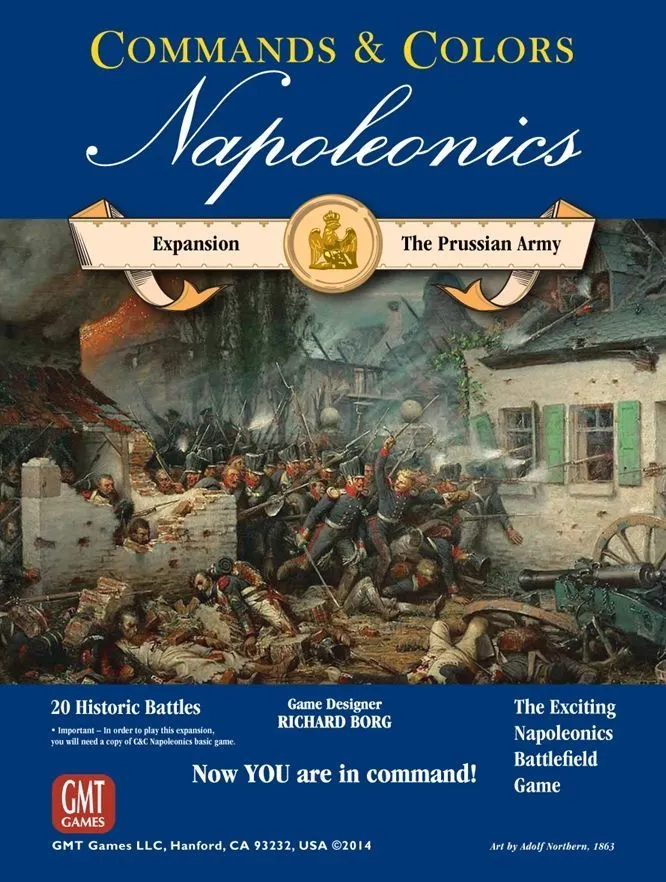
Expansion for Commands & Colors: Napoleonics
2014
Rules assistance for Commands & Colors: Napoleonics Expansion #4 – The Prussian Army
Plain-language explanations of turns, card effects and disputed situations, with official source references and saved question history.
What would you like to know?
Answers come from the official rulebook, with the page to check.
Commands & Colors: Napoleonics Expansion #4 – The Prussian Army is an expansion for Commands & Colors: Napoleonics released in 2014 for 2 players and 90 minutes per game. It was designed by Richard Borg and its main mechanics are Hand Management, Dice Rolling, and Hexagon Grid.



The Prussian Army is a Coalition expansion for Commands & Colors Napoleonics. During the Seven Years’ War, small Prussia under Frederick the Great defeated the armies of Austria, Russia, and France to increase the size of its territories two fold and become a major power in Europe. But in spite of Prussia’s reputation as a formidable fighting nation, Prussia withdrew from the First Coalition as an active opponent of the French Revolution and remain on the sidelines until the Fourth Coalition in 1806. In 1806, the Prussian Infantry were products of a system that had not altered since the Seven Years' War. The cavalry although probably the best mounted in Europe thanks to the East Prussian horse studs, were scattered amongst the army divisions at Jena, and were committed in numerous uncoordinated attacks. In general, the lack of coordination of the arms in combat was one of the major causes of the Prussian defeat at Jena. In the words of Napoleon… "At Jena, the Prussian army performed the finest and most spectacular maneuvers, but I soon put a stop to this tomfoolery and taught them that to fight and to execute dazzling maneuvers and wear splendid uniforms were very different matters." - Napoleon In 1806 Napoleon crushed the fearsome Prussian military machine. The humiliation of military defeat and being forced to cede much of its territories forced the Prussian king, Frederick William III, into much-needed military reform. The new Prussian army that emerged became one of the finest in Europe., due in part to the organizational genius of Scharnhorst and Gneisenau and in part due to Field-Marshal Prince Blücher, who drove his regiments to fight with relentless vigor. In 1813 Prussia rejoined the war against Napoleonic France and the Prussian army under Blücher, although sometimes playing second fiddle to Austria, Russia and Great Britain, was a major force in bringing an end to Napoleon Bonaparte's rule. In 1815 Napoleon returned to meet the English and Prussians, which would lead to his Waterloo. Prussia’s reward in 1815 at the Congress of Vienna was the recovery of her lost territories, as well as the whole of the Rhineland and Westphalia and other territories. Prussia therefore emerged from the Napoleonic Wars as the dominant power in Germany. In this expansion you will find 18 historical scenarios that focus on the Prussian Army battles from 1806 to 1815 against Napoleon, plus all the new units you’ll need to field for these engagements. - Richard Borg
Commands & Colors: Napoleonics Expansion #4 – The Prussian Army supports 2 players according to the catalogue. This is the publisher’s listed player count, so the game is designed for exactly that number of participants. Variants for other group sizes, if any, are described in the rulebook of your edition, so check it before setting up a different configuration.
The listed playing time for Commands & Colors: Napoleonics Expansion #4 – The Prussian Army is 90 minutes. This is the publisher’s estimate for a full game. The actual duration depends on the group, the player count and familiarity with the rules: first sessions usually run longer, while experienced groups often finish faster. Setup and teaching time are not included in this estimate.
Commands & Colors: Napoleonics Expansion #4 – The Prussian Army has a complexity rating of 2.3 out of 5 from BoardGameGeek players, which makes it a medium-light game. The rating reflects how much rules knowledge, planning and decision-making a typical game demands. Expect a longer first teach for heavier games, and use a preparation guide before game night.
Commands & Colors: Napoleonics Expansion #4 – The Prussian Army belongs to these categories: Wargame, Napoleonic, and Expansion for Base-game. Its main mechanics are Hand Management, Dice Rolling, and Hexagon Grid. Categories describe the theme and setting of a game, while mechanics describe what players actually do on their turns. Each mechanic links to a catalogue hub with similar games, which helps when you want something comparable.
The credited designers of Commands & Colors: Napoleonics Expansion #4 – The Prussian Army are: Richard Borg. These credits come from the published game data and name the people responsible for the game’s design, not its illustrators or publishers. Designer pages on MeepleRules collect other titles by the same designers, which helps when you enjoy a game and want to find similar ones.
The catalogue lists Commands & Colors: Napoleonics Expansion #4 – The Prussian Army as an expansion for Commands & Colors: Napoleonics. Expansions add new content, rules or scenarios to the base game and usually cannot be played on their own, so you need Commands & Colors: Napoleonics to use it. Check that your edition of Commands & Colors: Napoleonics is compatible, as some expansions were revised between editions.