- BGG rating
- 8.9
Gaia Project: The Lost Fleet
1–4 players60–150 min2024
Complexity 4.5/5
2017
Rules assistance for Gaia Project
Plain-language explanations of turns, card effects and disputed situations, with official source references and saved question history.
What would you like to know?
Answers come from the official rulebook, with the page to check.
Have the most victory points after round six; tied players share victory.
About 12 min · 9 steps
Step 1 of 9
Take one main action, plus any number of affordable free actions before or after it. You cannot take free actions after passing.
No. Start a Gaia Project there first, then build a mine after it becomes a Gaia Planet.
Each step costs 3, 2, or 1 ore, depending on your Terraforming research level.
Spend only power tokens in area III, moving them to area I.
Your turns end for the round. Take an available different booster, except in the final round.
Spend 4 knowledge to advance and flip a green federation token to gray. Only one player can reach level 5 in each research area.
It finishes in the following round. A project begun in the final round does not complete.
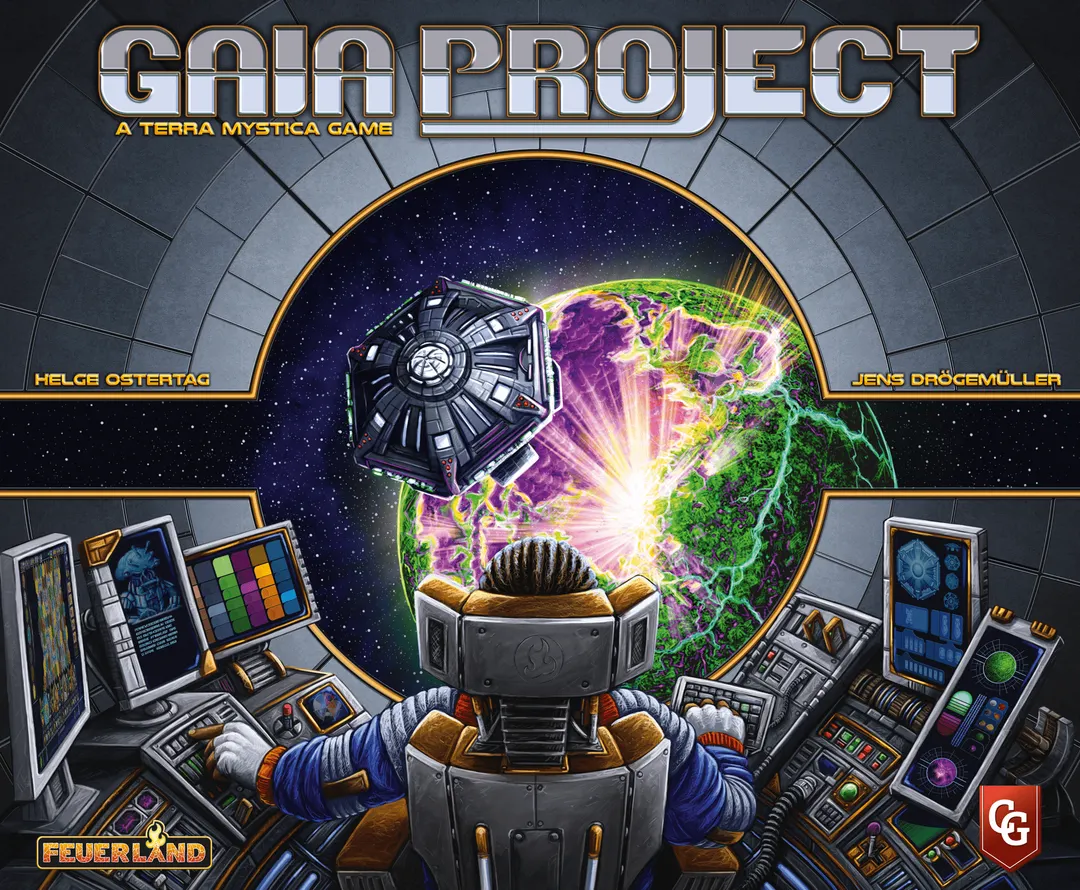
Gaia Project is a board game released in 2017 for 1–4 players, 60–150 minutes per game, and ages 12 and up. It was designed by Jens Drögemüller and Helge Ostertag and its main mechanics are Variable Player Powers, Income, and Variable Set-up. MeepleRules offers a rules assistant for Gaia Project that explains turns, card effects and disputed situations in plain language.

2–6 players90 min2004
1–5 players120 min2016

1–4 players60–120 min2025

2–4 players80–100 min2025

2–6 players60–200 min2020
1–5 players115 min2016

2–5 players60–90 min2019
1–4 players45–60 min2021
1–5 players90–120 min2019

1–4 players40–160 min2026
Expand, research, upgrade, and settle the galaxy with one of 14 factions. Gaia Project is the follow-up to the critically acclaimed Terra Mystica! 14 different factions live on 7 different kinds of planets, and each faction can only thrive on their specific type of planet. To develop and grow, a faction must terraform neighboring planets into their home environments while competing with the other factions. Special Gaia planets can be used by all factions and rare Transdimensional planets can be changed into Gaia planets! All factions can improve their skills in 6 unique areas of development which leads to advanced technology and special bonuses! To help out, each faction has its own unique special skills and abilities. A challenging solo experience is also included in Gaia Project! — description from the publisher
Use the rules assistant for Gaia Project to describe a turn, card effect or disputed situation. Get a plain-language explanation with official source references, then return to the question in your saved history. Select your edition when available so the sources match your game.
Ask about the rulesGaia Project supports 1–4 players according to the catalogue. This range comes from the publisher’s listed player count, so the game can be set up for any group size within it. Some setups, rules and scoring details may still vary by player count, so check your edition’s rulebook for the exact configuration.
The listed playing time for Gaia Project is 60–150 minutes. This is the publisher’s estimate for a full game. The actual duration depends on the group, the player count and familiarity with the rules: first sessions usually run longer, while experienced groups often finish faster. Setup and teaching time are not included in this estimate.
The catalogue lists Gaia Project for ages 12 and up. This is the publisher’s recommendation and reflects reading demands, rule complexity and small components rather than theme alone. Younger players can often join with help from an adult, so check the age guidance on your edition and consider your group’s experience with board games.
Gaia Project has a complexity rating of 4.4 out of 5 from BoardGameGeek players, which makes it a heavy game. The rating reflects how much rules knowledge, planning and decision-making a typical game demands. Expect a longer first teach for heavier games, and use a preparation guide before game night.
Gaia Project belongs to these categories: Economic, Territory Building, and Science Fiction. Its main mechanics are Variable Player Powers, Income, and Variable Set-up. Categories describe the theme and setting of a game, while mechanics describe what players actually do on their turns. Each mechanic links to a catalogue hub with similar games, which helps when you want something comparable.
The credited designers of Gaia Project are: Jens Drögemüller and Helge Ostertag. These credits come from the published game data and name the people responsible for the game’s design, not its illustrators or publishers. Designer pages on MeepleRules collect other titles by the same designers, which helps when you enjoy a game and want to find similar ones.
The catalogue lists Gaia Project as a base game. It can be played on its own with the components in the box and does not require any other title. Expansions, if any exist, add new content or rules on top of it and are listed separately in the catalogue with a link back to this base game.