
- BGG rating
- 8.0
J'Accuse!: The Inspector
- 3–6 players
- 2016
2016
Rules assistance for J'Accuse!
Plain-language explanations of turns, card effects and disputed situations, with official source references and saved question history.
What would you like to know?
Answers come from the official rulebook, with the page to check.
J'Accuse! is a board game released in 2016 for 3–6 players, 30–60 minutes per game, and ages 14 and up. It was designed by Jonathan Lavallee and its main mechanics are Take That, Simultaneous Action Selection, and Memory.

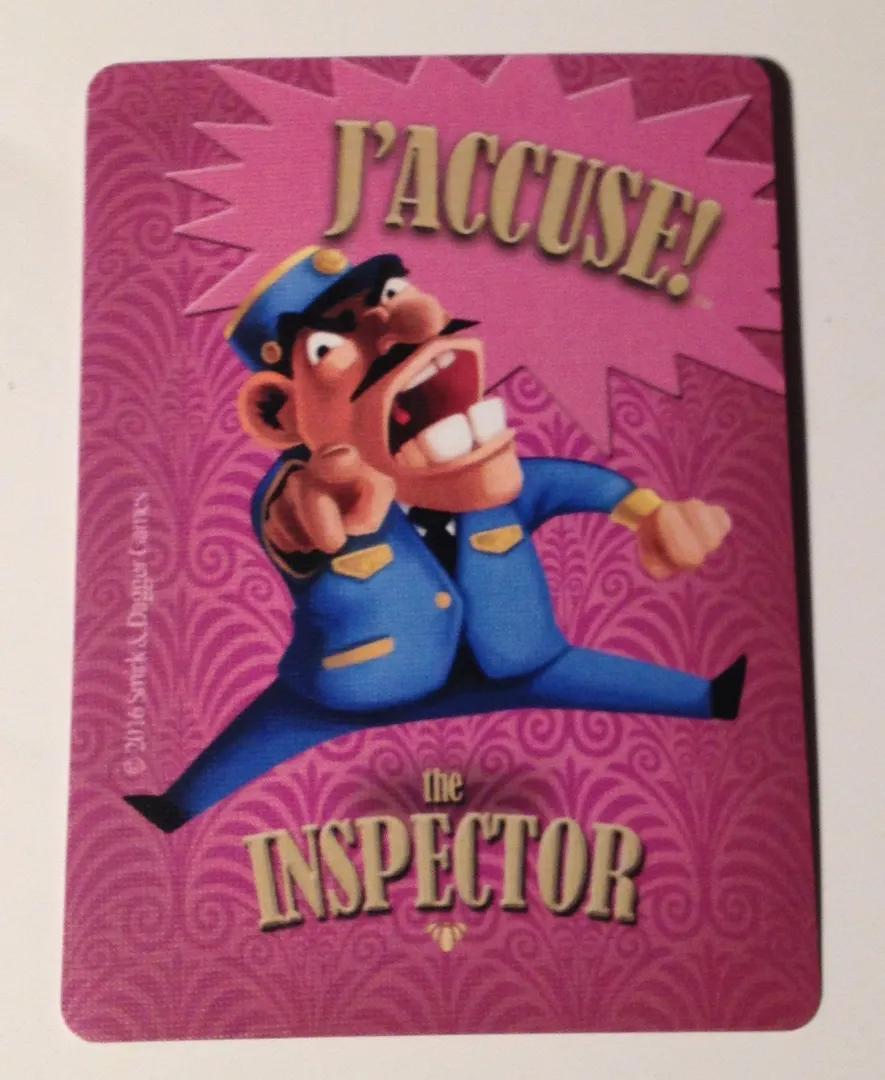
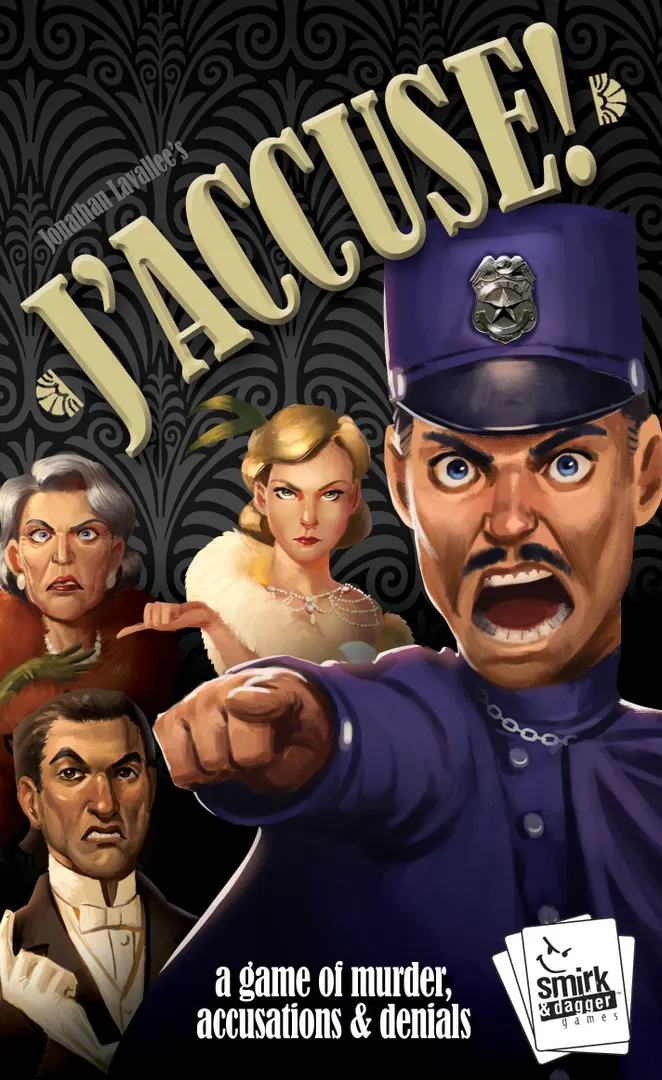
Mon dieu! M. Harpagon Richard is most decidedly dead, though not nearly soon enough for YOUR tastes, the old miser. His passing has brought you all together, feigning tears and anticipating your inheritance, when a terribly bothersome police inspector calls upon you. Chief Inspector Francois Cleu is not convinced that Harpagon passed peacefully in his sleep, as was reported. In fact, he's discovered "somewhat troubling evidence" that he was instead stabbed, poisoned, shot, strangled, bludgeoned and thrown out of a third story window. Worse, he seems to think YOU had something to do with it. Well, even if you did, which you didn't, there's no sense in all of you going to prison for it. That's why you've decided to "help" the Chief Inspector figure out who did! After all, you're the old man's heir and you're finally going to get what's coming to you...one way or another. J'Accuse! is about implicating and accusing your friends and family of murder — and no one "wins" the game so much as one of you will lose! The object is to avoid suspicion for as long as you can, while assuring that someone else ends up accused for the crime. The game ends, and the loser is "Arrested", when one player gets stuck with at least one of each type of Evidence (Motive, Opportunity and Weapon, which solves the case) OR by having ANY five pieces of Hard Evidence against them (a Preponderance of Evidence).
J'Accuse! supports 3–6 players according to the catalogue. This range comes from the publisher’s listed player count, so the game can be set up for any group size within it. Some setups, rules and scoring details may still vary by player count, so check your edition’s rulebook for the exact configuration.
The listed playing time for J'Accuse! is 30–60 minutes. This is the publisher’s estimate for a full game. The actual duration depends on the group, the player count and familiarity with the rules: first sessions usually run longer, while experienced groups often finish faster. Setup and teaching time are not included in this estimate.
The catalogue lists J'Accuse! for ages 14 and up. This is the publisher’s recommendation and reflects reading demands, rule complexity and small components rather than theme alone. Younger players can often join with help from an adult, so check the age guidance on your edition and consider your group’s experience with board games.
J'Accuse! has a complexity rating of 1.3 out of 5 from BoardGameGeek players, which makes it a light game. The rating reflects how much rules knowledge, planning and decision-making a typical game demands. Expect a longer first teach for heavier games, and use a preparation guide before game night.
J'Accuse! belongs to these categories: Card Game, Humor, and Murder / Mystery. Its main mechanics are Take That, Simultaneous Action Selection, and Memory. Categories describe the theme and setting of a game, while mechanics describe what players actually do on their turns. Each mechanic links to a catalogue hub with similar games, which helps when you want something comparable.
The credited designers of J'Accuse! are: Jonathan Lavallee. These credits come from the published game data and name the people responsible for the game’s design, not its illustrators or publishers. Designer pages on MeepleRules collect other titles by the same designers, which helps when you enjoy a game and want to find similar ones.
The catalogue lists J'Accuse! as a base game. It can be played on its own with the components in the box and does not require any other title. Expansions, if any exist, add new content or rules on top of it and are listed separately in the catalogue with a link back to this base game.