
- BGG rank
- BGG #21,563
- BGG rating
- 6.5
Vimy Ridge: Arras Diversion
- 1–2 players
- 60 min
- Complexity 2.1/5
- 2013
2012
Rules assistance for Loos: The Big Push
Plain-language explanations of turns, card effects and disputed situations, with official source references and saved question history.
For 2 players
What would you like to know?
Answers come from the official rulebook, with the page to check.
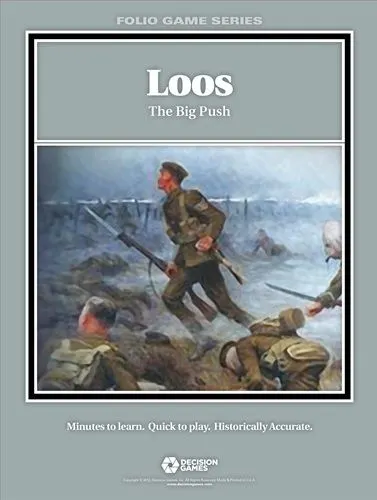
Loos: The Big Push is a board game released in 2012 for 2 players, 90 minutes per game, and ages 12 and up. It was designed by Chris Perello and its main mechanics are Hexagon Grid.




The French town of Loos (Lōs) was the British contribution to a massive Allied offensive on the Western Front in the Fall of 1915. Masterminded by the French General-in-Chief Joffre, the offensive was intended both to draw German strength away from the reeling Russians and to pinch out the German salient (“the Noyon Bulge”) aimed at Paris. Launched with limited artillery support and using several raw New Army divisions, the ostensible aim of the British attack was to seize the German rail lines behind the front, but in reality was a diversion for the main French offensive in Champagne. The British player, with a massive numerical superiority and heavy artillery support, must progress quickly. Powerful German reserves are nearby,and the battle becomes a race between the British advance and the German reaction. Loos uses a modification of the popular Fire & Movement game system. Developed to portray the mechanized battlefields of a later generation, F&M stresses the use of fire support to generate breakthroughs, followed by a rapid penetration by mobile reserves. At Loos, no one moved faster than a man on foot, and fire support was clumsy, unreliable, and inflexible. Thus the strength of that support is variable and serves as a precursor to combat rather than an enhancement of it. Exploitation is made only by units set aside for the purpose; they must be deployed behind (under) fighting units, and their subsequent movement is randomized. The fighting is attritional. The only way to avoid a stalemate is to mass troops and hammer away at an enemy sector until it breaks. Neither side has the forces to attack all along the line, so the location and direction of the attacks must be selected carefully. The player who makes the better choices will emerge the victor.
Loos: The Big Push supports 2 players according to the catalogue. This is the publisher’s listed player count, so the game is designed for exactly that number of participants. Variants for other group sizes, if any, are described in the rulebook of your edition, so check it before setting up a different configuration.
The listed playing time for Loos: The Big Push is 90 minutes. This is the publisher’s estimate for a full game. The actual duration depends on the group, the player count and familiarity with the rules: first sessions usually run longer, while experienced groups often finish faster. Setup and teaching time are not included in this estimate.
The catalogue lists Loos: The Big Push for ages 12 and up. This is the publisher’s recommendation and reflects reading demands, rule complexity and small components rather than theme alone. Younger players can often join with help from an adult, so check the age guidance on your edition and consider your group’s experience with board games.
Loos: The Big Push has a complexity rating of 2.1 out of 5 from BoardGameGeek players, which makes it a medium-light game. The rating reflects how much rules knowledge, planning and decision-making a typical game demands. Expect a longer first teach for heavier games, and use a preparation guide before game night.
Loos: The Big Push belongs to these categories: Wargame and World War I. Its main mechanics are Hexagon Grid. Categories describe the theme and setting of a game, while mechanics describe what players actually do on their turns. Each mechanic links to a catalogue hub with similar games, which helps when you want something comparable.
The credited designers of Loos: The Big Push are: Chris Perello. These credits come from the published game data and name the people responsible for the game’s design, not its illustrators or publishers. Designer pages on MeepleRules collect other titles by the same designers, which helps when you enjoy a game and want to find similar ones.
The catalogue lists Loos: The Big Push as a base game. It can be played on its own with the components in the box and does not require any other title. Expansions, if any exist, add new content or rules on top of it and are listed separately in the catalogue with a link back to this base game.