

- BGG rank
- BGG #3,975
- BGG rating
- 7.3
Aliens
- 1–9 players
- 90 min
- Complexity 2.2/5
- 1989
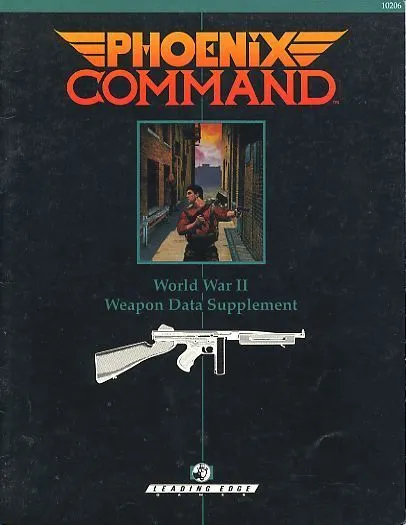
Rules assistance for Phoenix Command: World War II Weapon Data Supplement
Plain-language explanations of turns, card effects and disputed situations, with official source references and saved question history.
What would you like to know?
Answers come from the official rulebook, with the page to check.
Phoenix Command: World War II Weapon Data Supplement is an expansion for Phoenix Command released in 1988 for 2–12 players. It was designed by Barry Nakazono and David McKenzie.





While primarily thought of as a combat system for Leading Edge's Rhand Morningstar Missions RPG, the original Phoenix Command rules were also intended to be used for man-to-man skirmish wargaming, either on the tabletop or a hex map. Now the Phoenix Command Small Arms Combat System lets you join the battles of World War II, with more than 80 of the most memorable weapons used during the conflict. All the major powers are represented: France, Germany, Great Britain, Italy, Japan, the Soviet Union, and the United States. Included are:- Pistols, from the Japanese 8mm Taisho 14 to the British Webley Mk6 .455 Revolver - Sub-Machine Guns, from the German MP38/40 Schmeisser to the Allied Sten Mk2 and Mk3, and the famous Thompson "Tommygun" - Bolt Action and Semi-Automatic Rifles, from the U.S. Ml Garand to the German KAR 98K - Machine Guns, from the British Vickers Mkl to the German MG42 7.92mm Mauser - Explosives, from the German Stick Grenade to the U.S. "Pineapple" Grenade Fully illustrated, this supplement allows Phoenix Command players to include World War II and many post-war conflicts in their gaming. -from the back cover
Phoenix Command: World War II Weapon Data Supplement supports 2–12 players according to the catalogue. This range comes from the publisher’s listed player count, so the game can be set up for any group size within it. Some setups, rules and scoring details may still vary by player count, so check your edition’s rulebook for the exact configuration.
Phoenix Command: World War II Weapon Data Supplement belongs to these categories: Wargame, Miniatures, and Expansion for Base-game. Categories describe the theme, setting and style of a game rather than its rules. Filter the catalogue by the same category to find similar games when you enjoyed Phoenix Command: World War II Weapon Data Supplement and want something comparable for your next game night.
The credited designers of Phoenix Command: World War II Weapon Data Supplement are: Barry Nakazono and David McKenzie. These credits come from the published game data and name the people responsible for the game’s design, not its illustrators or publishers. Designer pages on MeepleRules collect other titles by the same designers, which helps when you enjoy a game and want to find similar ones.
The catalogue lists Phoenix Command: World War II Weapon Data Supplement as an expansion for Phoenix Command. Expansions add new content, rules or scenarios to the base game and usually cannot be played on their own, so you need Phoenix Command to use it. Check that your edition of Phoenix Command is compatible, as some expansions were revised between editions.