

- BGG rank
- BGG #3,216
- BGG rating
- 7.7
The Great Battles of Alexander: Deluxe Edition
- 1–4 players
- 240 min
- Complexity 3.6/5
- 1995
Rules assistance for Salamis
Plain-language explanations of turns, card effects and disputed situations, with official source references and saved question history.
What would you like to know?
Answers come from the official rulebook, with the page to check.
Salamis is an expansion for War Galley: Naval Warfare in the Ancient World released in 1999 for 2 players, 360 minutes per game, and ages 12 and up. It was designed by Richard H. Berg and Mark Herman and its main mechanics are Hexagon Grid.









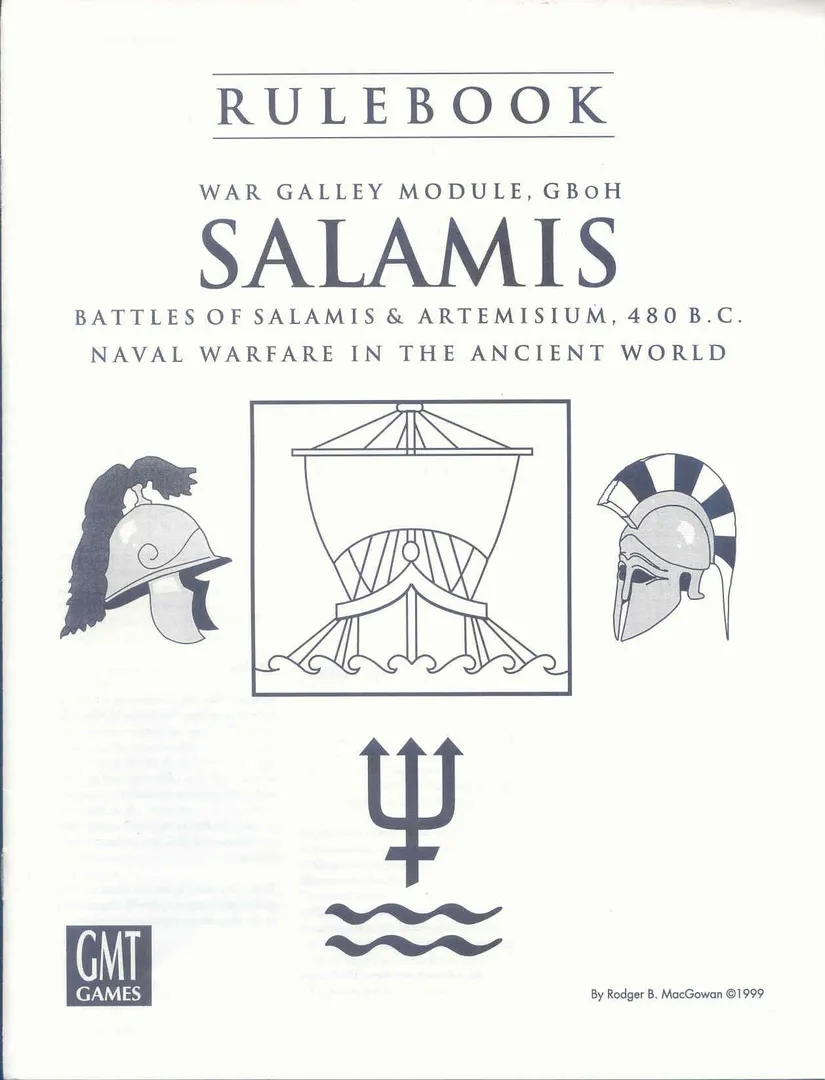
Add-on module for War Galley: Naval Warfare in the Ancient World. Salamis, one of the most famous naval battles in history, was a direct result of the Persian need to keep their large, invading army supplied by controlling the sea lanes. With Xerxes' army temporarily delayed at Thermopylae, the Greek fleet, based at Artemisium, some 50 miles or so directly east of Thermopylae, took the opportunity to attempt to stop the Persians from extending this Line of Communications. In a battle that appears to have extended over two or three days, the Greeks managed to eke out a slim tactical win. However, when Thermopylae fell, Themistocles' position became untenable, and the Greek fleet retreated to anchorage in the narrow channel of the Bay of Eleusis, west of Athens, at Salamis. With her naval flanks secured, the Persians rolled into lower Greece, capturing Athens and razing the town. However, to complete his subjugation of Greece, Xerxes had to destroy their fleet. To that end, the Persians sailed to a position south of Salamis. At Artemisium the Greeks had learned that, while their crews and marines were superior, the huge disparity in numbers could be telling. Unless they could neutralize this Persian strength. To that end, Themistocles lured the huge Persian fleet to attack the Greeks in the Bay of Eleusis, whose entrances were so restrictive as to negate any numerical superiority. There were two entrances to the bay. To plug up the western escape hatch, Xerxes dispatched his crack Egyptian squadron. Upon hearing this, Adeimantus and his Corinthians peeled off from the main fleet and sailed to the western mouth to block any Egyptian attempt to gain entrance. This "action" appears to have been a stand off, with both sides "blockading" and not fighting. At the eastern entrance, the Greeks deployed in three lines, along a narrow front of about 1800 yards, thus negating Persian numerical superiority. The Persians entered the bay in three long lines astern, which they then turned into nine lines abreast. The result was a boarding battle, and this was where the Greeks shone. Despite having half the manpower per ship of the Persians, their weaponry, armor and land-based tactics were superior to that of the Persians. And that superiority resulted in a smashing Greek victory. Xerxes retired to Thessaly, to try again the next year. The result was a great Greek victory, on land, at Plataea, followed by the Greek victory that completely cut Persian Lines of Communication, at Mycale. (from GMT website)
Salamis supports 2 players according to the catalogue. This is the publisher’s listed player count, so the game is designed for exactly that number of participants. Variants for other group sizes, if any, are described in the rulebook of your edition, so check it before setting up a different configuration.
The listed playing time for Salamis is 360 minutes. This is the publisher’s estimate for a full game. The actual duration depends on the group, the player count and familiarity with the rules: first sessions usually run longer, while experienced groups often finish faster. Setup and teaching time are not included in this estimate.
The catalogue lists Salamis for ages 12 and up. This is the publisher’s recommendation and reflects reading demands, rule complexity and small components rather than theme alone. Younger players can often join with help from an adult, so check the age guidance on your edition and consider your group’s experience with board games.
Salamis has a complexity rating of 3.1 out of 5 from BoardGameGeek players, which makes it a medium-weight game. The rating reflects how much rules knowledge, planning and decision-making a typical game demands. Expect a longer first teach for heavier games, and use a preparation guide before game night.
Salamis belongs to these categories: Wargame, Nautical, and Ancient. Its main mechanics are Hexagon Grid. Categories describe the theme and setting of a game, while mechanics describe what players actually do on their turns. Each mechanic links to a catalogue hub with similar games, which helps when you want something comparable.
The credited designers of Salamis are: Richard H. Berg and Mark Herman. These credits come from the published game data and name the people responsible for the game’s design, not its illustrators or publishers. Designer pages on MeepleRules collect other titles by the same designers, which helps when you enjoy a game and want to find similar ones.
The catalogue lists Salamis as an expansion for War Galley: Naval Warfare in the Ancient World. Expansions add new content, rules or scenarios to the base game and usually cannot be played on their own, so you need War Galley: Naval Warfare in the Ancient World to use it. Check that your edition of War Galley: Naval Warfare in the Ancient World is compatible, as some expansions were revised between editions.