

Schönbrunn: ioGioco 2-player variant
- 2–6 players
- 60 min
- 2019
2018
Rules assistance for Schönbrunn
Plain-language explanations of turns, card effects and disputed situations, with official source references and saved question history.
For 3 players
What would you like to know?
Answers come from the official rulebook, with the page to check.
Schönbrunn is a board game released in 2018 for 3–6 players, 60 minutes per game, and ages 12 and up. It was designed by Tommaso Bagnoli and its main mechanics are Set Collection, Auction / Bidding, and Area Majority / Influence.





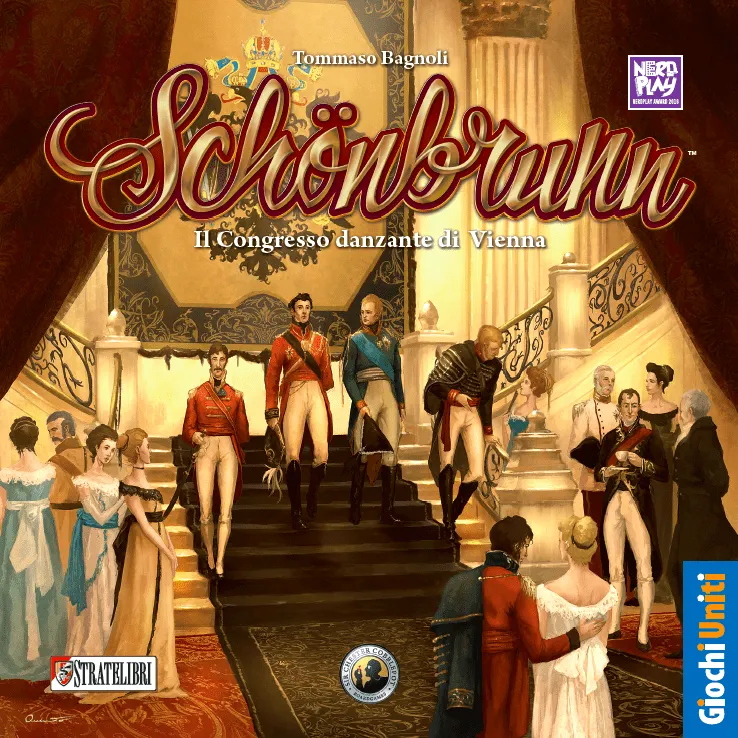
From November 1814 to June 1815, in the Castle of Schönbrunn in Austria, the famous Vienna Congress took place, in order to re-arrange the European balance of power after the Napoleonic wars. For the very first time, the great powers decided to prevent future conflicts by gathering around a negotiating table. Schönbrunn is a prestigious 3-6 player game. Each player acts on behalf of one of the six major European powers of the 19th century. Each turn, players send their delegates to sit around the different negotiating tables, according to an "imperfect information" mechanism. The game goal is to make the best use of delegates' power in order to obtain the biggest slice of the pie. Pay attention for each nation has its own features and special powers! ••• Dal Novembre 1814 al Giugno 1815, nel palazzo di Schönbrunn, a Vienna, capitale dell’Impero austriaco, le principali potenze europee inviarono i propri rappresentanti allo storico Congresso per ripristinare la geopolitica europea a seguito delle Guerre Napoleoniche. Per la prima volta gli stati europei decisero che il modo migliore di evitare i conflitti futuri era riunire tutte le nazioni interessate attorno allo stesso tavolo negoziale: un’idea che è sopravvissuta fino a oggi. Schönbrunn è un prestigioso gioco da tavolo per 3-6 influenti rappresentanti di altrettante potenti Nazioni europee dell’Ottocento. Durante ogni turno i giocatori inviano le proprie pedine delegato ai vari tavoli negoziali, in accordo a un meccanismo a “informazione imperfetta”. L’obiettivo è quello di sfruttare al meglio le proprie risorse al fine di ottenere il maggiore beneficio possibile dalle trattative. Ma fate attenzione, perché ogni Nazione in gioco dispone di un potere speciale!
Schönbrunn supports 3–6 players according to the catalogue. This range comes from the publisher’s listed player count, so the game can be set up for any group size within it. Some setups, rules and scoring details may still vary by player count, so check your edition’s rulebook for the exact configuration.
The listed playing time for Schönbrunn is 60 minutes. This is the publisher’s estimate for a full game. The actual duration depends on the group, the player count and familiarity with the rules: first sessions usually run longer, while experienced groups often finish faster. Setup and teaching time are not included in this estimate.
The catalogue lists Schönbrunn for ages 12 and up. This is the publisher’s recommendation and reflects reading demands, rule complexity and small components rather than theme alone. Younger players can often join with help from an adult, so check the age guidance on your edition and consider your group’s experience with board games.
Schönbrunn has a complexity rating of 3.4 out of 5 from BoardGameGeek players, which makes it a medium-weight game. The rating reflects how much rules knowledge, planning and decision-making a typical game demands. Expect a longer first teach for heavier games, and use a preparation guide before game night.
Schönbrunn belongs to these categories: Political and Negotiation. Its main mechanics are Set Collection, Auction / Bidding, and Area Majority / Influence. Categories describe the theme and setting of a game, while mechanics describe what players actually do on their turns. Each mechanic links to a catalogue hub with similar games, which helps when you want something comparable.
The credited designers of Schönbrunn are: Tommaso Bagnoli. These credits come from the published game data and name the people responsible for the game’s design, not its illustrators or publishers. Designer pages on MeepleRules collect other titles by the same designers, which helps when you enjoy a game and want to find similar ones.
The catalogue lists Schönbrunn as a base game. It can be played on its own with the components in the box and does not require any other title. Expansions, if any exist, add new content or rules on top of it and are listed separately in the catalogue with a link back to this base game.