

- BGG rank
- BGG #14,920
- BGG rating
- 7.6
Foreign Legion Paratroopers: Rapid Response Force
- 1–2 players
- Complexity 3.2/5
- 2020
2012
Rules assistance for Six Day War: 1967
Plain-language explanations of turns, card effects and disputed situations, with official source references and saved question history.
What would you like to know?
Answers come from the official rulebook, with the page to check.
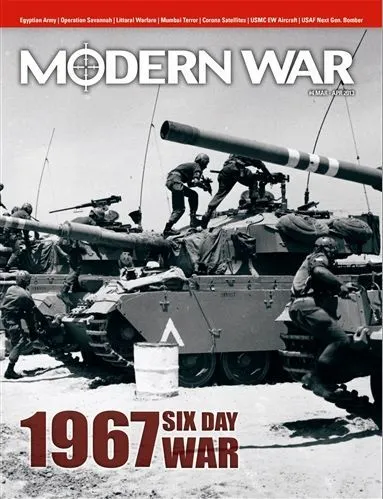
Six Day War: 1967 is a board game released in 2012 for 1–2 players. It was designed by Joseph Miranda and its main mechanics are Hexagon Grid, Simulation, and Solo / Solitaire Game.




Six Day War: 1967 is a wargame of Arab-Israeli War of June 1967. There are two players in the game, each commanding a Front of the Israeli Army against various Arab opponents. One commands the Sinai Front; the second commands the Eastern Front. Each player also commands the Arab forces facing the other player (his opponent.) The game is designed in this manner owing to the massive qualitative superiority of Israeli forces in this war. The assumption of the game is that an Israeli victory was generally inevitable, so the intent is to place the players in a situation in which they have to compete with each other on both sides to win the greatest possible victory on their own Front. The map is divided into two sectors, one for each Front. Only units of that Front may operate in that sector. There are additional units, called Reserves, which can possibly be assigned to either Front. The objective of each player is to score the most Victory Points in terms of seizing objectives and destroying enemy units at the lowest possible cost. Meanwhile, the player will be using the Arab forces facing the other player to delay or even stop that Front. The game includes one map (22x34”) of Israel and the surrounding regions from the Golan Heights to the Suez canal (and all of the Sinai), and one counter-sheet (228 counters) representing all of the Israeli and Arab forces, color-coded to apportion them by their respect Front. Published with Modern War #4
Six Day War: 1967 supports 1–2 players according to the catalogue. This range comes from the publisher’s listed player count, so the game can be set up for any group size within it. Some setups, rules and scoring details may still vary by player count, so check your edition’s rulebook for the exact configuration.
Six Day War: 1967 has a complexity rating of 3.5 out of 5 from BoardGameGeek players, which makes it a medium-weight game. The rating reflects how much rules knowledge, planning and decision-making a typical game demands. Expect a longer first teach for heavier games, and use a preparation guide before game night.
Six Day War: 1967 belongs to these categories: Wargame and Modern Warfare. Its main mechanics are Hexagon Grid, Simulation, and Solo / Solitaire Game. Categories describe the theme and setting of a game, while mechanics describe what players actually do on their turns. Each mechanic links to a catalogue hub with similar games, which helps when you want something comparable.
The credited designers of Six Day War: 1967 are: Joseph Miranda. These credits come from the published game data and name the people responsible for the game’s design, not its illustrators or publishers. Designer pages on MeepleRules collect other titles by the same designers, which helps when you enjoy a game and want to find similar ones.
The catalogue lists Six Day War: 1967 as a base game. It can be played on its own with the components in the box and does not require any other title. Expansions, if any exist, add new content or rules on top of it and are listed separately in the catalogue with a link back to this base game.