
- BGG rank
- BGG #2,398
- BGG rating
- 6.7
Kolejka
- 2–5 players
- 60 min
- Complexity 2.0/5
- 2011
2013
Rules assistance for Strajk! Skok do wolności
Plain-language explanations of turns, card effects and disputed situations, with official source references and saved question history.
What would you like to know?
Answers come from the official rulebook, with the page to check.
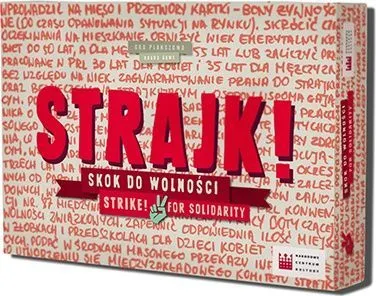
Strajk! Skok do wolności is a board game released in 2013 for 2–5 players, 45 minutes per game, and ages 12 and up. It was designed by Karol Madaj and its main mechanics are Point to Point Movement and Deck, Bag, and Pool Building.






In the game Strajk, (a.k.a. "Strike"), you get the chance to step into the shoes of Lech Wałęsa (pronounced "va-WEN-sa") and direct the activities of the Inter-Enterprise Strike Committee (MKS) in the Vladimir Lenin Shipyard in Gdańsk in August 1980. The time of the sympathy strike and negotiations of the 21 Demands with the government delegation, completed by signing the August Agreements and the emergence of Solidarność (the Solidarity movement), is the period when Lech Wałęsa scaled the shipyard fence and became not only the leader of the opposition, but also a front-page public figure. Because of the strike, he became the head of Solidarity, received the Nobel Peace Prize, and was elected President of the Republic of Poland. You begin the game with only your quick wit and gift of the gab. Everybody in turn controls the actions of Lech Wałęsa, gaining support for the strike in the shipyard. You use walking and running cards to move Wałęsa around the board. You use speech cards to win over the workers and residents of Gdańsk. With them on his side, Wałęsa draws the attention of foreign correspondents. Press interviews inform the entire country of the shipbuilders’ struggle, which causes other groups to join the strike, and the shipyard is visited by delegates of MKS (Międzyzakładowy Komitet Strajkowy: the Inter-Enterprise Strike Committee) and the MKS Committee of Experts under Tadeusz Mazowiecki. Being certain of support from the delegates and experts, you can attempt to negotiate the strike demands. The winner is the person who, as Lech Wałęsa, is the first to gain 2 demand cards. Will you be able to win over the crowd, gain favor in the eyes of the world, and lead the strike to victory?
Strajk! Skok do wolności supports 2–5 players according to the catalogue. This range comes from the publisher’s listed player count, so the game can be set up for any group size within it. Some setups, rules and scoring details may still vary by player count, so check your edition’s rulebook for the exact configuration.
The listed playing time for Strajk! Skok do wolności is 45 minutes. This is the publisher’s estimate for a full game. The actual duration depends on the group, the player count and familiarity with the rules: first sessions usually run longer, while experienced groups often finish faster. Setup and teaching time are not included in this estimate.
The catalogue lists Strajk! Skok do wolności for ages 12 and up. This is the publisher’s recommendation and reflects reading demands, rule complexity and small components rather than theme alone. Younger players can often join with help from an adult, so check the age guidance on your edition and consider your group’s experience with board games.
Strajk! Skok do wolności has a complexity rating of 2.2 out of 5 from BoardGameGeek players, which makes it a medium-light game. The rating reflects how much rules knowledge, planning and decision-making a typical game demands. Expect a longer first teach for heavier games, and use a preparation guide before game night.
Strajk! Skok do wolności belongs to these categories: Political and Educational. Its main mechanics are Point to Point Movement and Deck, Bag, and Pool Building. Categories describe the theme and setting of a game, while mechanics describe what players actually do on their turns. Each mechanic links to a catalogue hub with similar games, which helps when you want something comparable.
The credited designers of Strajk! Skok do wolności are: Karol Madaj. These credits come from the published game data and name the people responsible for the game’s design, not its illustrators or publishers. Designer pages on MeepleRules collect other titles by the same designers, which helps when you enjoy a game and want to find similar ones.
The catalogue lists Strajk! Skok do wolności as a base game. It can be played on its own with the components in the box and does not require any other title. Expansions, if any exist, add new content or rules on top of it and are listed separately in the catalogue with a link back to this base game.