
- BGG rank
- BGG #13,332
- BGG rating
- 6.7
The Franco-Prussian War
- 2 players
- 360–600 min
- Complexity 3.1/5
- 1992
1992
Rules assistance for The Russo-Turkish War, 1877-78
Plain-language explanations of turns, card effects and disputed situations, with official source references and saved question history.
For 2 players
What would you like to know?
Answers come from the official rulebook, with the page to check.
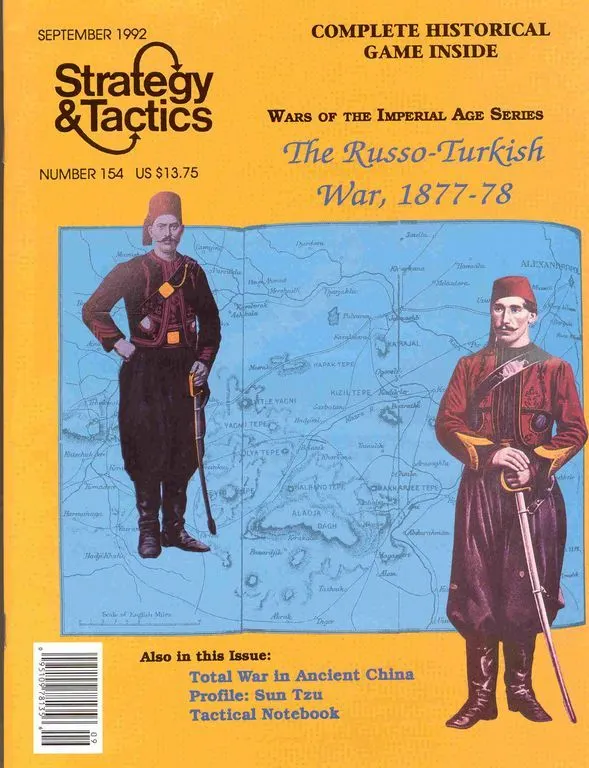
The Russo-Turkish War, 1877-78 is a board game released in 1992 for 2 players, 120 minutes per game, and ages 12 and up. It was designed by Joseph Miranda and its main mechanics are Dice Rolling and Hexagon Grid.
%2Fpic1139728.jpg@webp)

The Struggle between the Russian and Ottoman Empires was already centuries old when war broke out in 1877. It had its origins in the bitter conflict between Muslims and Christians, Slavs and Turks. The war proved to be a turning point in that it completely altered the balance of power in the east. In less than 40 years this helped produce the European catastrophe known as the Great War (WW I). Echoes of these ethnic and religious troubles resound today, as the peoples of Balkans and Near East still fight each other in a struggle for dominance. The Russo-Turkish War did not just cripple the Ottoman Empire. It made Russia into the dominant power in the East, and demonstrated the twin impact of modern technology and modern ideology on warfare. The System rules apply to all games in the Wars of the Imperial Age series, and simulate the conditions of warfare in the late 19th century. This is a revision of the System rules presented with Franco-Prussian War (S&T #149), and completely replaces the System rules book found there. Important changes from the original version are indicated by a double pound sign (##) at the beginning of the rule. Players familiarizing themselves with the game may wish to use just the System rules. The Specific Rules that apply only to the particular game and cover military and political conditions unique to the specific situation. Units represent historical leaders and headquarters staffs; corps, division-, and brigade-sized units; and fortifications. Each unit is rated for its combat strength, training class, and movement ability. (Specific Rules) Additionally, headquarters are rated for their Operations capability to enhance movement and combat capabilities, as well as conduct various politically oriented functions. All units are deployed face down, and are revealed to the enemy only if he conducts reconnaissance or intelligence operations. Movement is performed by the moving force rolling on one of four March tables (Regular March, Forced March, Railroad, Naval) and applying the result. Combat is fought between enemy units in individual adjacent hexes; each player draws a Battle Results marker at random. This gives the number of enemy combat factors eliminated, effects on enemy morale, and special results for cavalry, and siege guns.The typical size of units are brigades. Politics are a factor in the game. Each side has a National Will Index which gives the current level of popular support. This is affected by combat outcomes and other game events. (Specific Rules) Each turn, players have the opportunity to draw Political Events markers, representing various factors affecting the outcome of the conflict. Published in Strategy & Tactics magazine #154, Sep 1992. Errata was published in S&T #157 & 159. Replacement counters were issued in S&T #162 (2 counters) and S&T #171 (1 counter).
The Russo-Turkish War, 1877-78 supports 2 players according to the catalogue. This is the publisher’s listed player count, so the game is designed for exactly that number of participants. Variants for other group sizes, if any, are described in the rulebook of your edition, so check it before setting up a different configuration.
The listed playing time for The Russo-Turkish War, 1877-78 is 120 minutes. This is the publisher’s estimate for a full game. The actual duration depends on the group, the player count and familiarity with the rules: first sessions usually run longer, while experienced groups often finish faster. Setup and teaching time are not included in this estimate.
The catalogue lists The Russo-Turkish War, 1877-78 for ages 12 and up. This is the publisher’s recommendation and reflects reading demands, rule complexity and small components rather than theme alone. Younger players can often join with help from an adult, so check the age guidance on your edition and consider your group’s experience with board games.
The Russo-Turkish War, 1877-78 has a complexity rating of 3.2 out of 5 from BoardGameGeek players, which makes it a medium-weight game. The rating reflects how much rules knowledge, planning and decision-making a typical game demands. Expect a longer first teach for heavier games, and use a preparation guide before game night.
The Russo-Turkish War, 1877-78 belongs to these categories: Wargame and Post-Napoleonic. Its main mechanics are Dice Rolling and Hexagon Grid. Categories describe the theme and setting of a game, while mechanics describe what players actually do on their turns. Each mechanic links to a catalogue hub with similar games, which helps when you want something comparable.
The credited designers of The Russo-Turkish War, 1877-78 are: Joseph Miranda. These credits come from the published game data and name the people responsible for the game’s design, not its illustrators or publishers. Designer pages on MeepleRules collect other titles by the same designers, which helps when you enjoy a game and want to find similar ones.
The catalogue lists The Russo-Turkish War, 1877-78 as a base game. It can be played on its own with the components in the box and does not require any other title. Expansions, if any exist, add new content or rules on top of it and are listed separately in the catalogue with a link back to this base game.