
- BGG rank
- BGG #3,914
- BGG rating
- 8.3
Great War Commander
- 2–3 players
- 120 min
- Complexity 3.2/5
- 2018
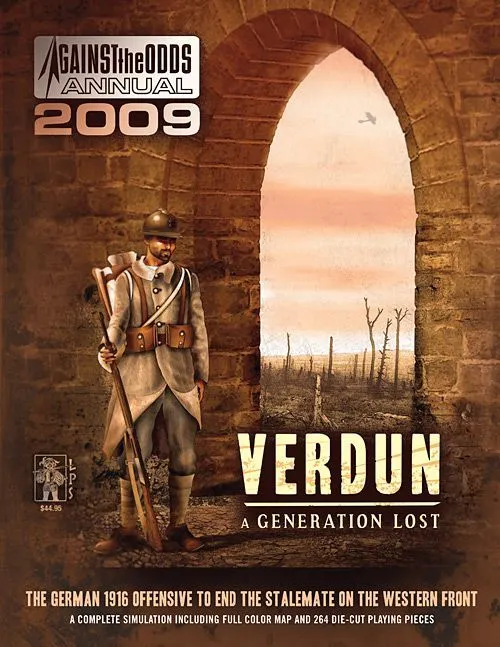
2009
Rules assistance for Verdun: A Generation Lost
Plain-language explanations of turns, card effects and disputed situations, with official source references and saved question history.
For 2 players
What would you like to know?
Answers come from the official rulebook, with the page to check.
Verdun: A Generation Lost is a board game released in 2009 for 2 players and 240 minutes per game. It was designed by Roger Nord and its main mechanics are Dice Rolling, Square Grid, and Hexagon Grid.

Hoping to bring a decisive conclusion along the Western Front despite the mud-and misery-filled trench deadlock, German General von Falkenhayn launched an attack from which the French could not retreat, and would prove costly for them to defend. The goal of the German offensive was the historic and symbolic city of Verdun. The German attack used new weapons such as poison gas, fighter airplanes to clear the skies of enemy observation planes, and a massive collection of artillery to devastate the defenders and obliterate the extensive French fortifications. The offensive was meant to inflict staggering casualties upon the defenders that would compel the Allies to negotiate. In the end, the Germans also suffered casualties that ran to the hundreds of thousands, making Verdun a symbol of war's inhumanity as well as tragic sacrifice. Designed by Roger Nord, Verdun: A Generation Lost is based on the same design as his other WWI game which appeared in Against the Odds magazine #11, The Big Push: The Battle for the Somme. Verdun: A Generation Lost features a 22" by 34" map that, like The Big Push, uses squares to regulate the game's functions, 264 large counters, and approximately 20 pages of rules and charts. Rules cover artillery, defensive fire, and close assault attacks, various types of weaponry, and there are six smaller scenarios covering pivotal aspects of the battle.
Verdun: A Generation Lost supports 2 players according to the catalogue. This is the publisher’s listed player count, so the game is designed for exactly that number of participants. Variants for other group sizes, if any, are described in the rulebook of your edition, so check it before setting up a different configuration.
The listed playing time for Verdun: A Generation Lost is 240 minutes. This is the publisher’s estimate for a full game. The actual duration depends on the group, the player count and familiarity with the rules: first sessions usually run longer, while experienced groups often finish faster. Setup and teaching time are not included in this estimate.
Verdun: A Generation Lost has a complexity rating of 3.2 out of 5 from BoardGameGeek players, which makes it a medium-weight game. The rating reflects how much rules knowledge, planning and decision-making a typical game demands. Expect a longer first teach for heavier games, and use a preparation guide before game night.
Verdun: A Generation Lost belongs to these categories: Wargame and World War I. Its main mechanics are Dice Rolling, Square Grid, and Hexagon Grid. Categories describe the theme and setting of a game, while mechanics describe what players actually do on their turns. Each mechanic links to a catalogue hub with similar games, which helps when you want something comparable.
The credited designers of Verdun: A Generation Lost are: Roger Nord. These credits come from the published game data and name the people responsible for the game’s design, not its illustrators or publishers. Designer pages on MeepleRules collect other titles by the same designers, which helps when you enjoy a game and want to find similar ones.
The catalogue lists Verdun: A Generation Lost as a base game. It can be played on its own with the components in the box and does not require any other title. Expansions, if any exist, add new content or rules on top of it and are listed separately in the catalogue with a link back to this base game.