
- BGG rank
- BGG #3,342
- BGG rating
- 7.8
Bolt Action
- 2–6 players
- 120 min
- Complexity 2.7/5
- 2012
2008
Rules assistance for WWII Eastern Front Skirmish Scenarios
Plain-language explanations of turns, card effects and disputed situations, with official source references and saved question history.
What would you like to know?
Answers come from the official rulebook, with the page to check.
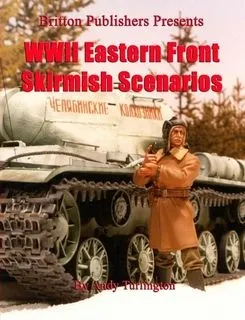
WWII Eastern Front Skirmish Scenarios is a board game expansion released in 2008 for 2–4 players and ages 12 and up. It was designed by Andrew Turlington and its main mechanics are Simulation and Scenario / Mission / Campaign Game.
WWII Eastern Front Skirmish Scenarios is a collection of 12 miniature skirmish scenarios. These scenarios are presented in a format that makes them easily playable with any set of rules that you may wish to use. Playtests were made using both 20mm and 28mm figures, and rules used were Soldat, Final Combat, Arc of Fire, Face of Combat, Rules of Engagement, Battleground, Nuts, Seven Brothers, and various sets of house rules. The scenarios included are: Battle of the Bzura 1939 Poland Operation Winter Storm 1942 Russia Fall Blau 1942 Russian Caucuses Pavlov's House 1942 Stalingrad Stalingrad Sniper Hunt 1942 Stalingrad (The only non historical scenario) Kharkov Must be Held 1943 Ukraine Defending Etligen 1943 Crimea The Battle of Krasny Bor 1943 Russia Tempelhof Bahn Station 1945 Berlin Lake Balaton 1945 Hungary Breakout at Baruth 1945 Germany Fall of Konigsberg 1945 Germany Each scenario gives: Historical Situation – the background to the actual action of which the skirmish game is ‘part of’. All of the scenarios are based on historical occurrences in the ‘big picture’. The action takes place as a ‘piece’ of this big picture, often revolving around some key action. Orders of Battle and Mission Briefing - Each side is given fixed number of troops and a mission briefing, what the orders are and how to achieve your objective. It is best if only one side is privy to their mission briefing. A Map – The maps are grid based and most tables are large if you were to play in 28mm. Judges notes – Final Combat works best if you use a games-master and the scenarios are really geared for this. In this section they will find guidelines for running the game, how to keep it tense, when to divulge information etc. But don’t worry if you don’t use a. This section includes the ‘Special Scenario rules’, which cover a wide range of detail from special movement, artillery incoming, communications, special morale considerations etc. Victory Conditions – Sometimes these are specific conditions that need to be met, sometimes they are a point based system.
WWII Eastern Front Skirmish Scenarios supports 2–4 players according to the catalogue. This range comes from the publisher’s listed player count, so the game can be set up for any group size within it. Some setups, rules and scoring details may still vary by player count, so check your edition’s rulebook for the exact configuration.
The catalogue lists WWII Eastern Front Skirmish Scenarios for ages 12 and up. This is the publisher’s recommendation and reflects reading demands, rule complexity and small components rather than theme alone. Younger players can often join with help from an adult, so check the age guidance on your edition and consider your group’s experience with board games.
WWII Eastern Front Skirmish Scenarios belongs to these categories: Wargame, Miniatures, and World War II. Its main mechanics are Simulation and Scenario / Mission / Campaign Game. Categories describe the theme and setting of a game, while mechanics describe what players actually do on their turns. Each mechanic links to a catalogue hub with similar games, which helps when you want something comparable.
The credited designers of WWII Eastern Front Skirmish Scenarios are: Andrew Turlington. These credits come from the published game data and name the people responsible for the game’s design, not its illustrators or publishers. Designer pages on MeepleRules collect other titles by the same designers, which helps when you enjoy a game and want to find similar ones.
The catalogue lists WWII Eastern Front Skirmish Scenarios as an expansion. Expansions add new content, rules or scenarios to an existing base game and usually cannot be played on their own. Check the box or publisher description for the exact base game required, and make sure your edition of that game is compatible with this expansion.