
- Rang BGG
- BGG #8 883
- Note BGG
- 7,8
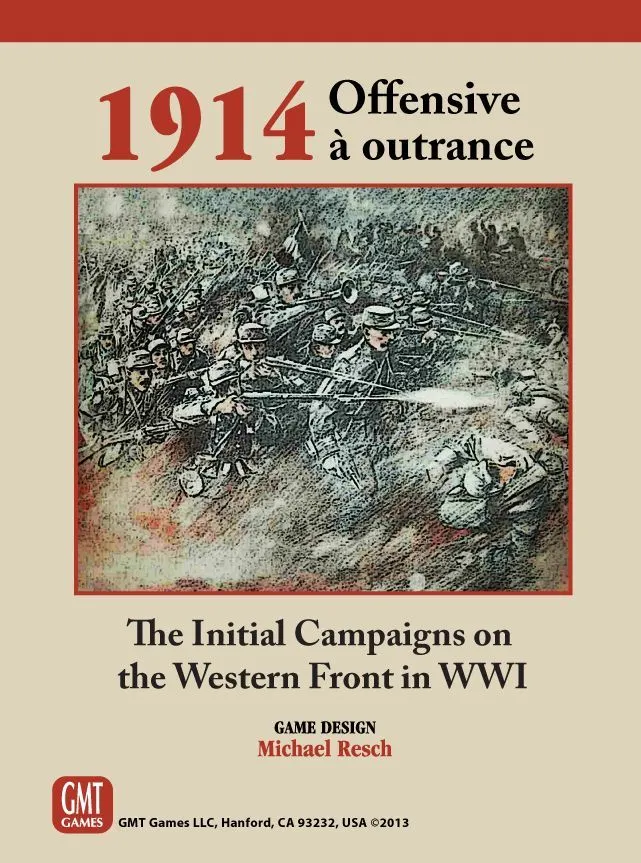
1914: Offensive à outrance
- 1–4 joueurs
- Complexité 4,0/5
- 2013
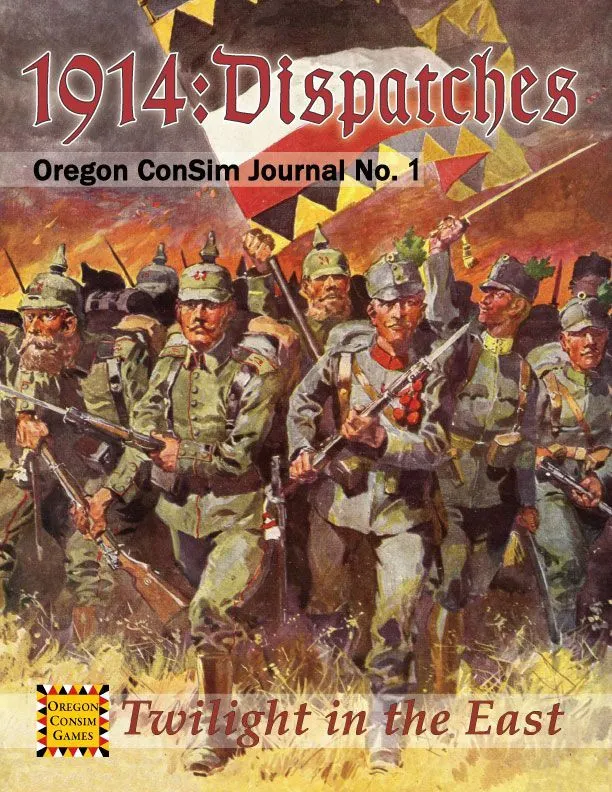
Aide aux règles de 1914: Dispatches – Twilight in the East
Des explications claires des tours, effets de cartes et situations litigieuses, avec des références aux sources officielles et un historique des questions sauvegardé.
Que voulez-vous savoir ?
Les réponses viennent du livret officiel, avec la page à vérifier.
1914: Dispatches – Twilight in the East est une extension de 1914: Twilight in the East sortie en 2012 pour 2 à 6 joueurs. Il a été conçu par Michael Resch et ses principales mécaniques sont Dice Rolling, Hexagon Grid et Simulation.






En anglais
1914: Dispatches is the first issue of Oregon ConSim Journal (a Charles S Roberts Award winning magazine), is a support magazine that focuses on the Eastern Front during 1914 by expanding on the CSR Award winning WWI simulation game 1914: Twilight in the East (TitE). During the design of 1914 TitE a great deal of research material was accumulated that was not incorporated due to space (and time) limitations. The Journal allows some of this material to be brought to light, more thoroughly covering the fascinating 1914 time period. The centerpiece of the publication is a collection of three well-researched historical articles that are paired with new scenarios allowing the subject to be accurately simulated. The time period October–November 1914 contained two distinct campaigns that culminated in very large battles fought in Russian Poland: The Battle of Ivangorod and Battles of Lodz and Krakau. These battles are the topics chosen for two of the scenarios found in the journal. The first, “The Battle of Ivangorod,” is a small introductory scenario that covers the time period 22–26 October when the Austro-Hungarian First Army unsuccessfully fought to clear the Russians from their Vistula River bridgeheads at Ivangorod and Kozienice. Following the Battle of Ivangorod, in early November the German high command acted to regain the operational initiative and protect Germany from the ravages of invasion. Using their excellent railroad network to transfer large bodies of troops, they launched an offensive to penetrate deep into the main Russian forces’ flank and rear. The epic operation is the subject of the Journal’s second scenario, “The Battles of Lodz and Krakau.” This expert scenario, intended for veteran players, is huge, requiring all five maps and almost the entire counter mix. A well known military axiom states: mistakes made in the deployment of troops at the start of operations cannot be righted in the course of the whole campaign. At the outset of WWI this was true for all fronts but nowhere was it more pertinent than on the Eastern Front. The Journal’s third article, “Austria-Hungary’s Botched Deployment in 1914” concentrates on that nation’s botched initial strategic deployment. The game strategy article Playing Both Sides in Galicia details successful opening moves on the Galician front. Based on years of gameplay experience by the designer, the article presents a corps-by-corps breakdown of Austro-Hungarian and Russian armies and offers tested solutions for the challenges they face. Rounding out the contents are two enhanced, professionally-produced Player Aid Cards designed to speed combat resolution in 1914, Twilight in the East. Journal Contents (64 pages): The Austro-Hungarian Army and National Identity 1867–1914 Austria-Hungary’s Botched Deployment in 1914 associated scenario: The Austro-Hungarian Deployment Plan as of Winter 1913/14 (18 counters to be mounted - see expansion counters) Playing Both Sides in Galicia — Galicia Campaign Strategies Prelude to Ivangorod associated scenario: The Battle of Ivangorod (introductory scenario GT 28-29) The Lodz Campaign: Defeating the Russian Steamroller associated scenario: The Battles of Lodz & Krakau (complete scenario GT 36-47) The Polish Legion in 1914 Revised Victory Conditions for the Grand Campaign scenario Also included: Two replacement Player Aid Cards for 1914, Twilight in the East See preview pages. (Source: publisher and BGG user)
Selon le catalogue, 1914: Dispatches – Twilight in the East se joue de 2 à 6 personnes. Cette fourchette correspond au nombre de joueurs indiqué par l’éditeur : le jeu s’installe donc pour toute taille de groupe dans cette limite. La mise en place, certaines règles et le décompte peuvent varier selon l’effectif ; vérifiez la configuration exacte dans la règle de votre édition.
1914: Dispatches – Twilight in the East obtient une note de complexité de 3,0 sur 5 auprès des joueurs de BoardGameGeek, ce qui en fait un jeu de complexité moyenne. Cette note reflète la quantité de règles, de planification et de décisions qu’exige une partie typique. Prévoyez une explication plus longue pour les jeux exigeants et utilisez un guide de préparation avant la soirée.
1914: Dispatches – Twilight in the East appartient à ces catégories : Wargame, Expansion for Base-game et World War I. Ses principales mécaniques sont Dice Rolling, Hexagon Grid et Simulation. Les catégories décrivent le thème et l’univers d’un jeu, tandis que les mécaniques décrivent ce que les joueurs font réellement pendant leur tour. Chaque mécanique mène à une page du catalogue avec des jeux similaires.
Les auteurs crédités pour 1914: Dispatches – Twilight in the East sont : Michael Resch. Ces crédits proviennent des données publiées du jeu et désignent les personnes responsables de sa conception, et non les illustrateurs ou les éditeurs. Les pages d’auteurs sur MeepleRules regroupent les autres titres des mêmes auteurs, ce qui est utile lorsqu’un jeu vous plaît et que vous en cherchez de similaires.
Le catalogue présente 1914: Dispatches – Twilight in the East comme une extension de 1914: Twilight in the East. Les extensions ajoutent du contenu, des règles ou des scénarios au jeu de base et ne se jouent généralement pas seules : il vous faut donc 1914: Twilight in the East pour l’utiliser. Vérifiez que votre édition de 1914: Twilight in the East est compatible, car certaines extensions ont été révisées d’une édition à l’autre.