- Note BGG
- 9,0
Iganie 1831
- 2 joueurs
- 150–240 min
- Complexité 3,4/5
- 2018
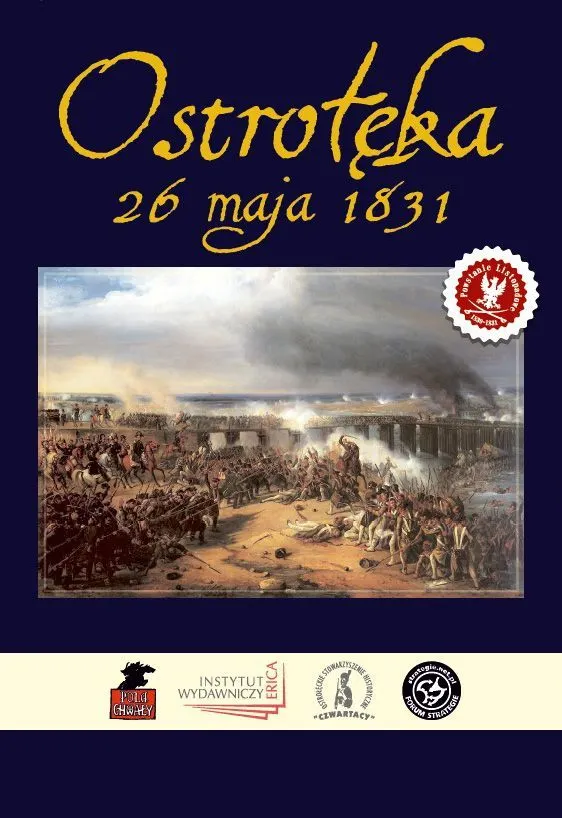
2015
Aide aux règles de Ostroleka 26 maja 1831
Des explications claires des tours, effets de cartes et situations litigieuses, avec des références aux sources officielles et un historique des questions sauvegardé.
Que voulez-vous savoir ?
Les réponses viennent du livret officiel, avec la page à vérifier.
Ostroleka 26 maja 1831 est un jeu de société sorti en 2015 pour 2 à 4 joueurs, avec des parties de 180 à 600 minutes et à partir de 16 ans. Il a été conçu par Ryszard Kita et ses principales mécaniques sont Dice Rolling, Hexagon Grid et Variable Phase Order.






En anglais
Ostrołęka 26 maja 1831 covers the battle of Ostrołęka, one of the largest engagements of Poland’s November Uprising. It was fought between Polish army commanded by general Jan Skrzynecki and Russian army commanded by field marshal Ivan Diebitsch. The battle was the final part of the operation of Polish army against Russian Imperial Guard. The meeting near Ostrołęka was a bit suprising for both sides, especially for Poles who didn’t expect such quick appearance of Russian forces near their positions. Polish army was divided into two parts. The first part was situated on the eastern bank of the river Narew. The second, larger part was put on the western bank of the river. In Ostrołęka there were two bridges connecting both banks of the river (one of them was pontoon bridge). The first part of the battle was fought on the eastern bank of Narew. Polish forces tried to slow down an assault of Russians and withdraw to the western bank. Unfortunately, in consequence of earlier orders, one of Polish infantry brigades commanded by general Bogusławski was stayed to defend town Ostrołęka (situated on the eastern bank of the river), and there attacked by overwhelming Russians and partially routed, partially destroyed. Russians took control over Ostrołęka at noon. Then some Russian grenadier battalions decided to cross the river through the bridges to create a bridgehead for further operations. So started the second part of the battle. Polish main army began attacks to destroy Russian bridgehead and both brigdes to prevent main body of Russian army to cross the river. There were few attacks. At first they were not properly coordinated. Russian small forces on the bridgehead was supported by powerful artillery situated on the eastern bank of the river which was higher than western bank and allowed crossing fire (Russians formed two great batteries, one to the north and one to the south of Ostrołęka, and were shooting over own units on the western bank). In the later afternoon Polish attacks became more coordinated. Russians tried to gain more terrain, but it moved them out of the range of their supporting artillery and encouraged Polish army to make last, most powerful attack, which was stopped near to the river. The battle ended a famous charge of Polish horse artillery battery commanded by lt. col. J. Bem, which caused great chaos in the Russian forces and discouraged Russians to make general cavalry attack on Polish army in the end of the battle as they were used to do in the Napoleonic Wars. When battle ended, both sides had similar casualties (about 6 000 killed, wounded etc.). The battle is considered Polish army defeat because it left the battlefield and during the night and the next day started retreat, not chased by Russians who first weren’t sure they had won. The main effect of the battle for Poles was the fall of morale of soldiers and the upper command, which allowed Russians to take initiative in the later part of Polish-Russian War. Ostrołęka 26 maja 1831 contains three scenarios, with one made to introduce players to the system and two historical ones, showing both parts of the battlle. The game is quite complex, tending to show full spectrum of tactic of the Napoleonic and Post-Napoleonic period, but in reasonably easy way. Basic game mechanic is similar to Igo/Ugo movement, but with two phases of movement: for cavalry and infantry, and two combat phases: for cavalry and infantry. Horse artillery is generally attached to cavalry and foot artillery is attached to infantry. Additional rules offer another movement systems but rather designed for further battles based on this rules, not for that one. Rules offer many possible reaction activities for non-active player during opposite player phase. Another rules feature is an unique combat calculation system based on traditional odds ratio but originally modified. The rules focuse on simulating cooperation of three kinds of weapon (infantry, cavalry and artillery) on the battlefield and showing different formations (column, line, square, skirmish, buildings defense). The playing time varies depending on the scenario, from 2-3 hours to whole day. It also depends on the players – the longest scenario can be finished very quickly by autowin. Components: - One mapsheet 96 x 68 cm - Nine sheets of die-cut counters (978 counters totally, most of them are markers) - One sheet of additional counters - One rulebook and scenariobook (both in one book) - Three dices (D6) - Six sheets with tables and player aids - One sheet with units tables (alternative way of marking units loses)
Selon le catalogue, Ostroleka 26 maja 1831 se joue de 2 à 4 personnes. Cette fourchette correspond au nombre de joueurs indiqué par l’éditeur : le jeu s’installe donc pour toute taille de groupe dans cette limite. La mise en place, certaines règles et le décompte peuvent varier selon l’effectif ; vérifiez la configuration exacte dans la règle de votre édition.
La durée indiquée pour Ostroleka 26 maja 1831 est de 180 à 600 minutes, selon l’estimation de l’éditeur pour une partie complète. La durée réelle dépend du groupe, de l’effectif et de la connaissance des règles : les premières parties sont plus longues, les groupes expérimentés terminent plus vite. Mise en place et explication des règles ne sont pas comprises.
Le catalogue indique Ostroleka 26 maja 1831 à partir de 16 ans. C’est la recommandation de l’éditeur ; elle tient compte de la lecture nécessaire, de la complexité des règles et des petits composants, pas seulement du thème. Les plus jeunes peuvent souvent participer avec l’aide d’un adulte : vérifiez l’âge indiqué sur votre édition et tenez compte de l’expérience de votre groupe.
Ostroleka 26 maja 1831 obtient une note de complexité de 3,9 sur 5 auprès des joueurs de BoardGameGeek, ce qui en fait un jeu exigeant. Cette note reflète la quantité de règles, de planification et de décisions qu’exige une partie typique. Prévoyez une explication plus longue pour les jeux exigeants et utilisez un guide de préparation avant la soirée.
Ostroleka 26 maja 1831 appartient à ces catégories : Wargame et Post-Napoleonic. Ses principales mécaniques sont Dice Rolling, Hexagon Grid et Variable Phase Order. Les catégories décrivent le thème et l’univers d’un jeu, tandis que les mécaniques décrivent ce que les joueurs font réellement pendant leur tour. Chaque mécanique mène à une page du catalogue avec des jeux similaires.
Les auteurs crédités pour Ostroleka 26 maja 1831 sont : Ryszard Kita. Ces crédits proviennent des données publiées du jeu et désignent les personnes responsables de sa conception, et non les illustrateurs ou les éditeurs. Les pages d’auteurs sur MeepleRules regroupent les autres titres des mêmes auteurs, ce qui est utile lorsqu’un jeu vous plaît et que vous en cherchez de similaires.
Le catalogue présente Ostroleka 26 maja 1831 comme un jeu de base. Il se joue seul avec le matériel contenu dans la boîte et ne nécessite aucun autre titre. Les extensions, s’il en existe, y ajoutent du contenu ou des règles et sont répertoriées séparément dans le catalogue, avec un lien vers ce jeu de base.