

- BGG rank
- BGG #18,331
- BGG rating
- 7.2
The Battle of Stalingrad
- 2 players
- Complexity 2.2/5
- 2012
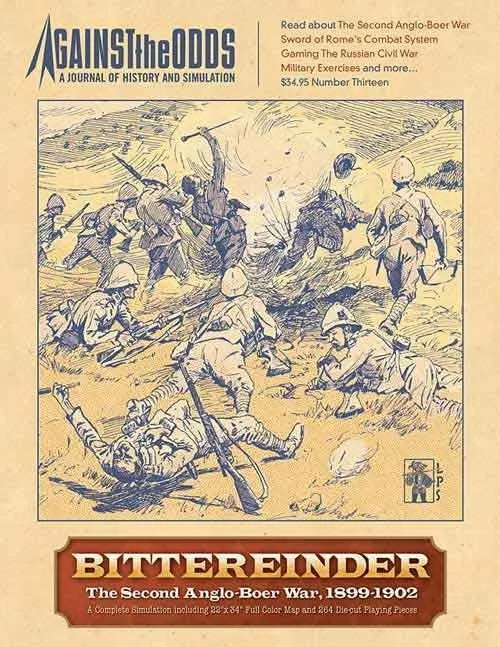
2000
Rules assistance for Bittereinder: The Second Anglo-Boer War, 1899-1902
Plain-language explanations of turns, card effects and disputed situations, with official source references and saved question history.
For 2 players
What would you like to know?
Answers come from the official rulebook, with the page to check.
Bittereinder: The Second Anglo-Boer War, 1899-1902 is a board game released in 2000 for 2 players, 480 minutes per game, and ages 12 and up. It was designed by Hjalmar Gerber and its main mechanics are Hexagon Grid.




Bittereinder is a two-player simulation of the entire 2nd Anglo-Boer War of 1899 to 1902. It depicts the events arising from President (of the Zuid Afrikaansche Republiek - ZAR) Paul Kruger's ultimatum to the British Empire on October 9, 1899, demanding the following: • The withdrawal of British troops on the borders of the ZAR, • Discontinuing the British military build-up in South Africa, and • Settling all differences between Britain and the ZAR through arbitration. The Republic of the Orange Free State threw its lot in with their Boer (literal translation: farmers) brethren in the ZAR. At 17:00 on 11 October 1899 the ultimatum expired. The British Empire was at war with the Boers, the white tribe of Africa. The war would straddle the centuries, ending on May 31, 1902. It was a bitter defeat for the Boers and a victory bereft of glory for the world's mightiest empire. Full color 22"x34" map 264 full color 5/8" die cut counters Rulebook length - 14 pages Charts and tables - 2 pages Complexity - Medium Solitaire suitability - Medium Playing time - 8 hours
Bittereinder: The Second Anglo-Boer War, 1899-1902 supports 2 players according to the catalogue. This is the publisher’s listed player count, so the game is designed for exactly that number of participants. Variants for other group sizes, if any, are described in the rulebook of your edition, so check it before setting up a different configuration.
The listed playing time for Bittereinder: The Second Anglo-Boer War, 1899-1902 is 480 minutes. This is the publisher’s estimate for a full game. The actual duration depends on the group, the player count and familiarity with the rules: first sessions usually run longer, while experienced groups often finish faster. Setup and teaching time are not included in this estimate.
The catalogue lists Bittereinder: The Second Anglo-Boer War, 1899-1902 for ages 12 and up. This is the publisher’s recommendation and reflects reading demands, rule complexity and small components rather than theme alone. Younger players can often join with help from an adult, so check the age guidance on your edition and consider your group’s experience with board games.
Bittereinder: The Second Anglo-Boer War, 1899-1902 has a complexity rating of 2.7 out of 5 from BoardGameGeek players, which makes it a medium-light game. The rating reflects how much rules knowledge, planning and decision-making a typical game demands. Expect a longer first teach for heavier games, and use a preparation guide before game night.
Bittereinder: The Second Anglo-Boer War, 1899-1902 belongs to these categories: Wargame and Post-Napoleonic. Its main mechanics are Hexagon Grid. Categories describe the theme and setting of a game, while mechanics describe what players actually do on their turns. Each mechanic links to a catalogue hub with similar games, which helps when you want something comparable.
The credited designers of Bittereinder: The Second Anglo-Boer War, 1899-1902 are: Hjalmar Gerber. These credits come from the published game data and name the people responsible for the game’s design, not its illustrators or publishers. Designer pages on MeepleRules collect other titles by the same designers, which helps when you enjoy a game and want to find similar ones.
The catalogue lists Bittereinder: The Second Anglo-Boer War, 1899-1902 as a base game. It can be played on its own with the components in the box and does not require any other title. Expansions, if any exist, add new content or rules on top of it and are listed separately in the catalogue with a link back to this base game.