

- BGG rank
- BGG #5,411
- BGG rating
- 7.0
Across 5 Aprils
- 2 players
- 60–360 min
- Complexity 2.3/5
- 1992
2019
Rules assistance for Kernstown
Plain-language explanations of turns, card effects and disputed situations, with official source references and saved question history.
For 1 player
What would you like to know?
Answers come from the official rulebook, with the page to check.
Kernstown is a board game released in 2019 for 1–2 players, 120–480 minutes per game, and ages 13 and up. It was designed by Claude Whalen and its main mechanics are Dice Rolling, Grid Movement, and Hexagon Grid.



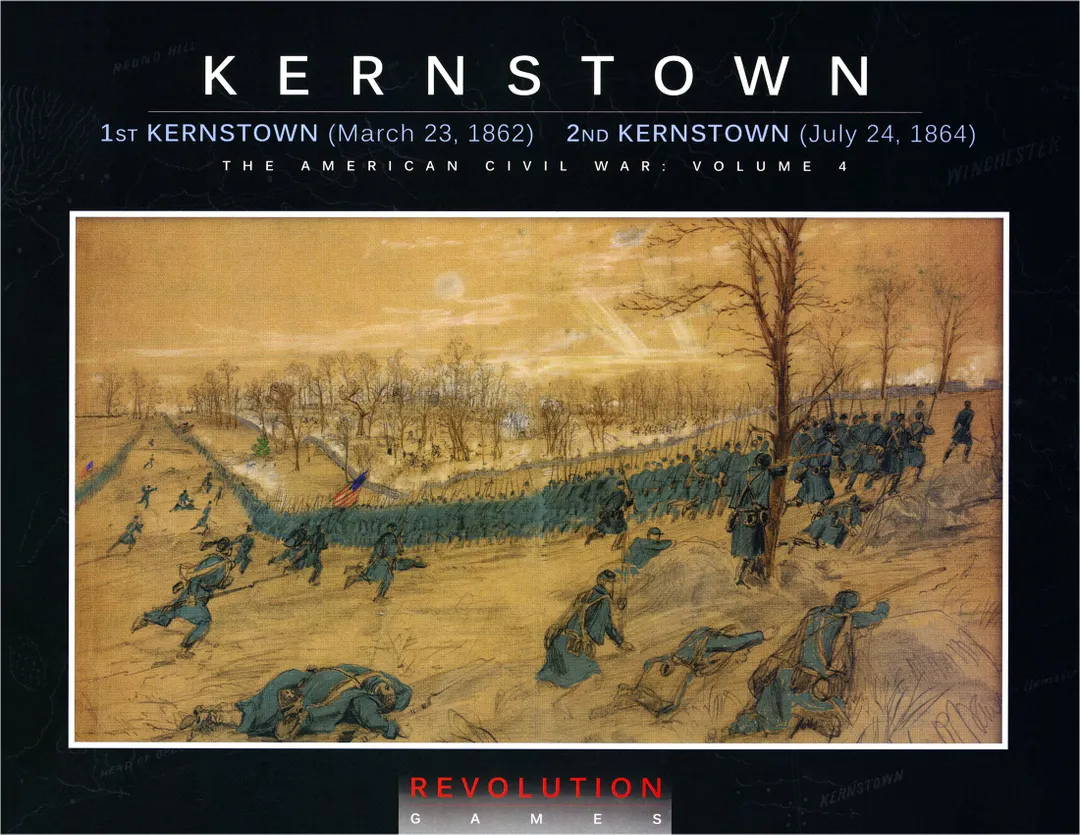
On March 23, 1862 and then again on July 24, 1864 the area around Kernstown, Virginia witnessed clashes between Union and Confederate forces. The Pritchard House and Pritchard's Hill were central to both battles as they abutted the Valley Turnpike. At First Kernstown, Stonewall Jackson erred in taking scouting reports at face value and so he unknowingly attacked a superior Union force. With Union Commander James Shields laying wounded back in Winchester, Colonel Nathan Kimball ignored Shields' orders and managed, and mismanaged, the battle his way. Though Jackson's men ran out of ammunition and fled the field, Stonewall's only tactical loss became a strategic victory as Union Commanders overestimated the size of Jackson's force. The Union forces could have crushed Jackson, stopped his Valley Campaign before it really got started and perhaps allowed McClellan to end the war in 1862. On July 24, 1864, Union Commander George Crook ignored his scouting reports and ordered his forces to attack what he thought was a small body of Confederate cavalry and skirmishers. Generals Jubal Early and especially General John Breckinridge led their forces well and routed Crook's men. Only the failure of the Confederate cavalry to cut the Union retreat routes prevented the annihilation of Crook's army. Better Union leadership and troop placement could have made this battle much harder for the Confederates to win. Kernstown is a game simulating the fighting on March 23, 1862 and July 24, 1864 around Kernstown. The game is specifically designated to be a playable regimental-scale simulation of these two conflicts and some scenarios can be completed in a long evening. This is the fourth ACW game published by Revolution Games which features the "Blind Swords" chit-pull system. This mechanic emphasizes the three "FOW's" of military conflict: fog-of-war, friction-of-war, and fortunes-of-war. With each chit pull, players will be challenged to make tough decisions based on their assessment of the situation at that moment. Components: One 22x34" map; 2 x 5/8" counter-sheets (352 counters); Rulebooklet; 5 charts/playeraids; Box or ziploc bag; 2 dice (Boxed version only). Game Information: Complexity: 6 out of 10. Solitaire Suitability: 6 out of 10. Time Scale: 20 minute turns. Map Scale: 140 yards per hex. Unit Scale: regimental. Players: one to two, best with two. Playing Time: three to ten hours depending on scenario. —description from the publisher Map by Rick Barber Counters by Charlie Kibler Box by Mark Mahaffey
Kernstown supports 1–2 players according to the catalogue. This range comes from the publisher’s listed player count, so the game can be set up for any group size within it. Some setups, rules and scoring details may still vary by player count, so check your edition’s rulebook for the exact configuration.
The listed playing time for Kernstown is 120–480 minutes. This is the publisher’s estimate for a full game. The actual duration depends on the group, the player count and familiarity with the rules: first sessions usually run longer, while experienced groups often finish faster. Setup and teaching time are not included in this estimate.
The catalogue lists Kernstown for ages 13 and up. This is the publisher’s recommendation and reflects reading demands, rule complexity and small components rather than theme alone. Younger players can often join with help from an adult, so check the age guidance on your edition and consider your group’s experience with board games.
Kernstown has a complexity rating of 3.3 out of 5 from BoardGameGeek players, which makes it a medium-weight game. The rating reflects how much rules knowledge, planning and decision-making a typical game demands. Expect a longer first teach for heavier games, and use a preparation guide before game night.
Kernstown belongs to these categories: Wargame, Civil War, and Post-Napoleonic. Its main mechanics are Dice Rolling, Grid Movement, and Hexagon Grid. Categories describe the theme and setting of a game, while mechanics describe what players actually do on their turns. Each mechanic links to a catalogue hub with similar games, which helps when you want something comparable.
The credited designers of Kernstown are: Claude Whalen. These credits come from the published game data and name the people responsible for the game’s design, not its illustrators or publishers. Designer pages on MeepleRules collect other titles by the same designers, which helps when you enjoy a game and want to find similar ones.
The catalogue lists Kernstown as a base game. It can be played on its own with the components in the box and does not require any other title. Expansions, if any exist, add new content or rules on top of it and are listed separately in the catalogue with a link back to this base game.