

- BGG rank
- BGG #13,103
- BGG rating
- 7.2
NATO, Nukes & Nazis
- 2 players
- 180 min
- Complexity 3.8/5
- 1990
2012
Rules assistance for Operation Anaconda: Battle in Afghanistan, March 2002
Plain-language explanations of turns, card effects and disputed situations, with official source references and saved question history.
What would you like to know?
Answers come from the official rulebook, with the page to check.
Operation Anaconda: Battle in Afghanistan, March 2002 is a board game released in 2012 for 1–2 players and 120 minutes per game. It was designed by Joseph Miranda and its main mechanics are Hexagon Grid.





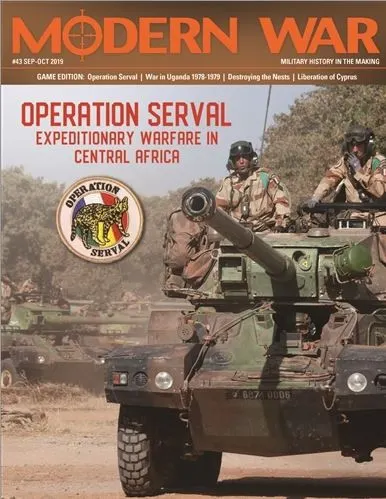

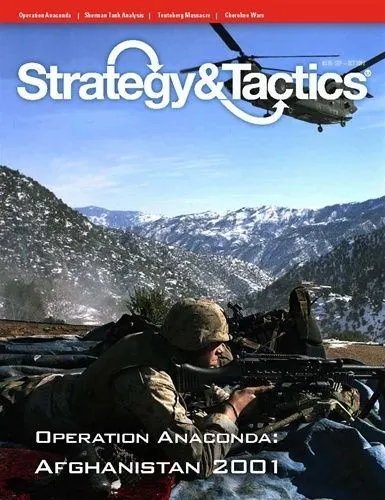
From the publisher' website: Operation Anaconda, the battle fought between Coalition forces and Al Qaeda in eastern Afghanistan in March of 2002. This battle was a combined US-Afghan-Coalition force attempt to surround and destroy Al Qaeda forces, but the operation fell apart owing to poor command control. While technically a Coalition victory, the battle demonstrated the strengths and weaknesses of both sides. The game system is based on the "Boots" system, which makes command-control the central feature of the design. Each player commands a combat force composed of one or more sub-commands. These sub-commands are maneuvered via picking Command Chits at random; When a Command Chit is picked, that sub-command is then activated. Since players do not know the order in which those Command Chits are picked, battles become chaotic fights as players strive to create and exploit opportunities. This is a two-player game, with one player commanding Coalition forces, and the other Al Qaeda. Combat in the game is quasi-tactical. Units fire at enemy targets at range. Additionally, the Coalition player has access to various types of fire support, such as airstrikes. However, owing to the chaotic nature of the battle, fire support as well as various reinforcements appear at random. The Al Qaeda player has the advantage of his units being deployed face down so that the Coalition player must use ISR (Intelligence-Surveillance-Reconnaissance) to reveal them. Game play becomes a tense contest between asymmetrical forces in the mountains of Afghanistan.
Operation Anaconda: Battle in Afghanistan, March 2002 supports 1–2 players according to the catalogue. This range comes from the publisher’s listed player count, so the game can be set up for any group size within it. Some setups, rules and scoring details may still vary by player count, so check your edition’s rulebook for the exact configuration.
The listed playing time for Operation Anaconda: Battle in Afghanistan, March 2002 is 120 minutes. This is the publisher’s estimate for a full game. The actual duration depends on the group, the player count and familiarity with the rules: first sessions usually run longer, while experienced groups often finish faster. Setup and teaching time are not included in this estimate.
Operation Anaconda: Battle in Afghanistan, March 2002 has a complexity rating of 1.8 out of 5 from BoardGameGeek players, which makes it a light game. The rating reflects how much rules knowledge, planning and decision-making a typical game demands. Expect a longer first teach for heavier games, and use a preparation guide before game night.
Operation Anaconda: Battle in Afghanistan, March 2002 belongs to these categories: Wargame and Modern Warfare. Its main mechanics are Hexagon Grid. Categories describe the theme and setting of a game, while mechanics describe what players actually do on their turns. Each mechanic links to a catalogue hub with similar games, which helps when you want something comparable.
The credited designers of Operation Anaconda: Battle in Afghanistan, March 2002 are: Joseph Miranda. These credits come from the published game data and name the people responsible for the game’s design, not its illustrators or publishers. Designer pages on MeepleRules collect other titles by the same designers, which helps when you enjoy a game and want to find similar ones.
The catalogue lists Operation Anaconda: Battle in Afghanistan, March 2002 as a base game. It can be played on its own with the components in the box and does not require any other title. Expansions, if any exist, add new content or rules on top of it and are listed separately in the catalogue with a link back to this base game.