
- BGG rank
- BGG #8,885
- BGG rating
- 8.0
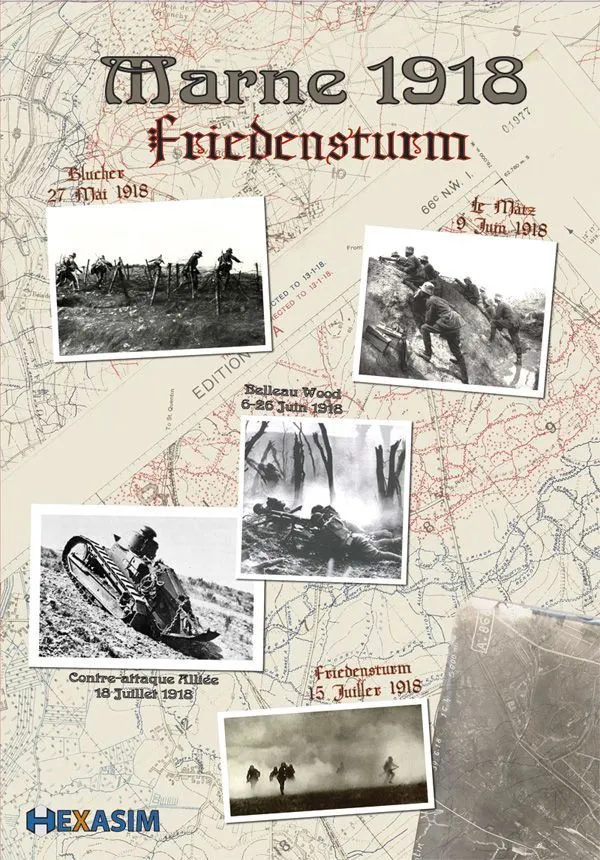
Marne 1918: Friedensturm
- 2 players
- 210–1200 min
- Complexity 3.2/5
- 2006
2012
Rules assistance for Somme 1918: Bloody Spring
Plain-language explanations of turns, card effects and disputed situations, with official source references and saved question history.
For 2 players
What would you like to know?
Answers come from the official rulebook, with the page to check.
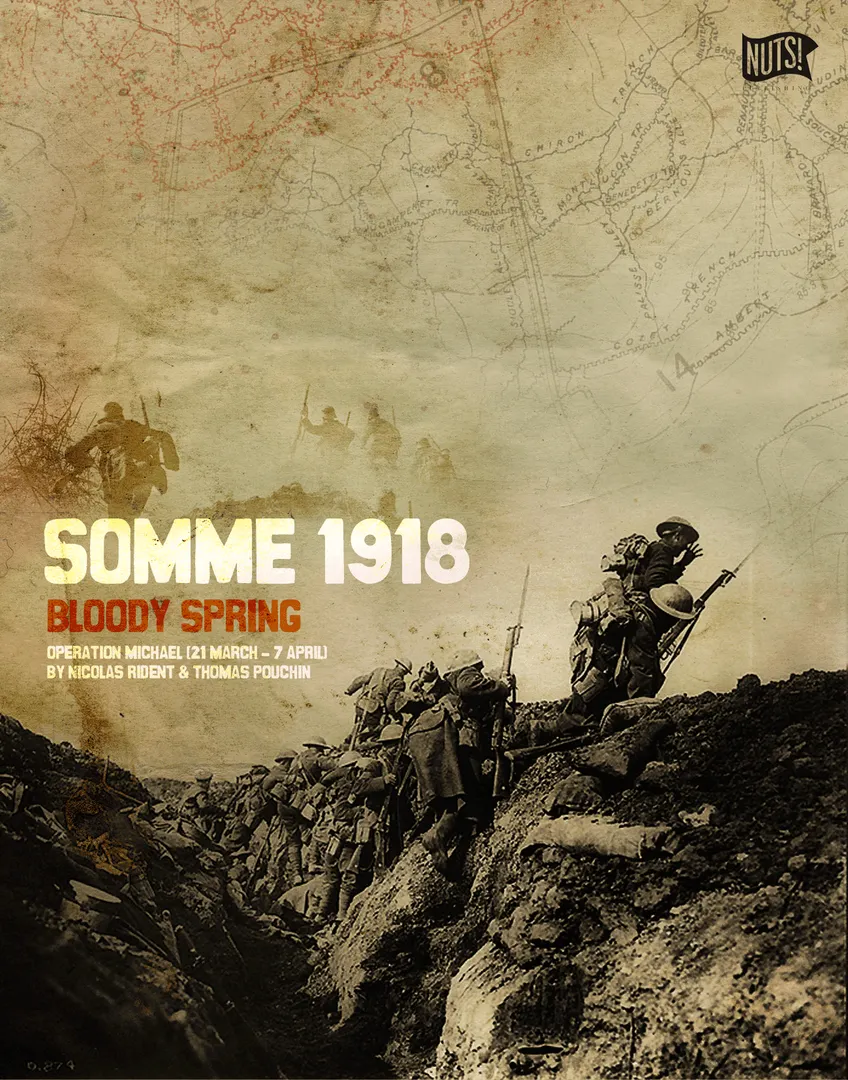
Somme 1918: Bloody Spring is a board game released in 2012 for 2 players, 240 minutes per game, and ages 14 and up. It was designed by Nicolas Rident and Thomas Pouchin and its main mechanics are Dice Rolling, Hexagon Grid, and Simulation.






Somme 1918 is the second game in a series that covers all of the offensives on the Western Front in 1918 and the Sequel to Marne 1918: Friedensturm. Somme 18 is different from Marne 1918 because it covers only one battle, Operation Michael, while Marne 1918 simulated a series of offensives, from Blucher to Friedensturm. The result is a more intense and nerve-wracking game that takes place over eight turns (from the end of March to mid-April), at least half of which are composed of three operational phases. Both players will face difficult challenges. The German player needs to re-create the historic breakthrough and has to put in every effort to reach Amiens. The Allied player has to resist succumbing to panic in the first turns in order to organize an effective defense, and then a counter-attack near the end of the game. While the basic rules in Somme 18 are identical to those in Marne 1918 (with the exception of the air rules, which have been completely revised), the advanced rules will be very different. The principal reason is the length of Operation Michael, about fifteen days, which does not give an opportunity for the campaign management rules of Marne 1918 to be used. So, all of the unit management tracks have disappeared and have been replaced by one table that manages the replacement and re-construction of units. Strategic movement has also been greatly simplified and adapted to the tempo of the game. Somme 1918 will of course be enriched by numerous specific rules, simulating the particularities of this battle. Petain’s Reticence: Simulates the French command’s lack of urgency in supporting their British allies. The arrival of French reinforcements without their artillery support, allowing a quicker deployment of troops coupled with a reduction in their value. Inter-Allied Cooperation: This will be extremely reduced at the beginning of the campaign. Evolution of the use of Stoss: The doctrine of using assault troops had been principally introduced by General von Hutier, in Russia and Italy. At the beginning of Operation Michael, the generals commanding the Second and Seventeenth armies used their Stosstruppen in frontal assaults, wasting these elite forces and provoking fury from Ludendorff. A rule thus simulates the evolution of this doctrine. The Doullens Conference: At the height of the German offensive, while the French Army under Petain prepared to cut its ties with the British, Haig accepted that he be placed under the command of Foch, finally creating an inter-Allied command. This rule simulates this conference, tied to German conquests. It also plays a part in obtaining victory points. In fact, this rule is really the heart of the game and we think that players will be pleased with the proposed system that will bring together the different parameters of this game. • Boxed game • 1 A1 single-sided maps • About 560 counters • 24 pages rules booklet in english • 2 player aids in english • Introductory historical booklet with design notes • 4 dice (from Nuts Publishing website)
Somme 1918: Bloody Spring supports 2 players according to the catalogue. This is the publisher’s listed player count, so the game is designed for exactly that number of participants. Variants for other group sizes, if any, are described in the rulebook of your edition, so check it before setting up a different configuration.
The listed playing time for Somme 1918: Bloody Spring is 240 minutes. This is the publisher’s estimate for a full game. The actual duration depends on the group, the player count and familiarity with the rules: first sessions usually run longer, while experienced groups often finish faster. Setup and teaching time are not included in this estimate.
The catalogue lists Somme 1918: Bloody Spring for ages 14 and up. This is the publisher’s recommendation and reflects reading demands, rule complexity and small components rather than theme alone. Younger players can often join with help from an adult, so check the age guidance on your edition and consider your group’s experience with board games.
Somme 1918: Bloody Spring has a complexity rating of 3.6 out of 5 from BoardGameGeek players, which makes it a medium-weight game. The rating reflects how much rules knowledge, planning and decision-making a typical game demands. Expect a longer first teach for heavier games, and use a preparation guide before game night.
Somme 1918: Bloody Spring belongs to these categories: Wargame and World War I. Its main mechanics are Dice Rolling, Hexagon Grid, and Simulation. Categories describe the theme and setting of a game, while mechanics describe what players actually do on their turns. Each mechanic links to a catalogue hub with similar games, which helps when you want something comparable.
The credited designers of Somme 1918: Bloody Spring are: Nicolas Rident and Thomas Pouchin. These credits come from the published game data and name the people responsible for the game’s design, not its illustrators or publishers. Designer pages on MeepleRules collect other titles by the same designers, which helps when you enjoy a game and want to find similar ones.
The catalogue lists Somme 1918: Bloody Spring as a base game. It can be played on its own with the components in the box and does not require any other title. Expansions, if any exist, add new content or rules on top of it and are listed separately in the catalogue with a link back to this base game.