

- BGG rank
- BGG #8,299
- BGG rating
- 7.2
Rebel Raiders on the High Seas
- 2 players
- 360 min
- Complexity 2.7/5
- 2013
2019
Rules assistance for The Late Unpleasantness: Two Campaigns to take Richmond
Plain-language explanations of turns, card effects and disputed situations, with official source references and saved question history.
For 2 players
What would you like to know?
Answers come from the official rulebook, with the page to check.
The Late Unpleasantness: Two Campaigns to take Richmond is a board game released in 2019 for 2 players, 120–240 minutes per game, and ages 13 and up. It was designed by Steve Ruwe and its main mechanics are Dice Rolling, Point to Point Movement, and Simulation.







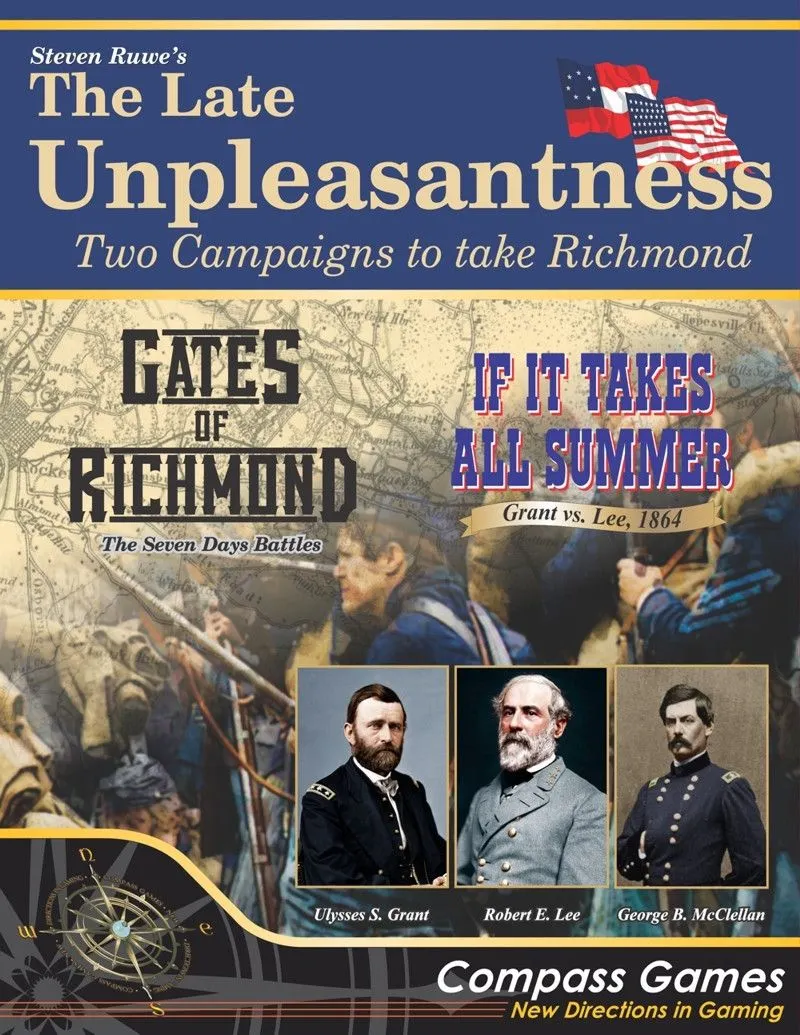
“Two Civil War Campaigns to take Richmond” In the spring of 1861, Richmond, Virginia became the capital of the Confederacy. Being a manufacturing powerhouse only 120 miles from Washington DC and the Confederate capital, it became the focus of Union attention. The threat of capture by Federal forces was constant. The Late Unpleasantness covers the two major attempts to capture the Confederate Capital City. Gates of Richmond covers the Seven Days Battles with Robert E Lee facing down George McClellan. If It Takes All Summer is Ulysses S Grant’s overland campaign of 1864, which added the names of Wilderness, Spotsylvania Courthouse and Cold Harbor to Civil War history. Each game stands alone, but share the majority of rules. Simple enough to learn and play in an evening, but enough twists and turns to make you want to replay it until it is worn. The maps use a point to point movement system, rather than hexes to simulate the campaigning over the road networks and river crossings, rather than mass movements cross country. Combat is integrated into the movement, making coordination of large bodies of troops difficult. The Gates of Richmond map covers the area from Richmond in the west to the White House on the Pamunkey, and from Mechanicsville south to Harrison’s Landing. Key features such as Malvern Hill, Beaver Dam Creek, and the bridges over White Oak swamp and the Chickahominy are highlighted. Will the Union army fail to attack the Richmond works as a result of “Prince John” Magruder’s antics? If It Takes All Summer covers most of Central Virginia, from Brandy Station and Culpeper to the Cold Harbor north east of Richmond. The Wilderness features prominently in the campaign with a special table to create some of the confusion as a result of fighting in this tangle. The basic units are divisions (a bit larger than usual for Civil War, but right in this case). Each unit is listed for strength and overall leadership/morale quality. Stacks are hidden for limited intelligence. Corps and Army leaders are available to modify the die roll in an attack as well as to help coordinate attacks from more than a single stack. Sequence of play is straight forward with supply first. Units out of supply suffer movement and combat penalties and those with a continued lack of supply will suffer attrition. Confederate supply is a simple trace to either Richmond or a railroad, while the Union needs to relocate his base to keep his offensive moving. Units move, then attack as a part of the stack’s movement. Terrain, strength and leadership are all die roll modifiers, in combat. Combat losses are in terms of strength points, but a third die is rolled to determine if the combat ends in a retreat or continues. If it continues, you count it up and do it again. (and possibly again) If your leaders are good enough, they may be able to break off a losing battle. Thrown into the mix are random events cards, but the game is not card driven. Each player can hold a hand of up to 10 cards, which can be played in nearly any combination and at any time (except during combat continuation). You use the cards to enhance your units or mess with the other player (ie. Grant steals a march - all Union units +2 MP this turn, or Rain - 1 left shift on all attacks) Others are one time events (Sedwick gets killed, Jackson falls asleep) that will ruin your perfect plan. Each game can be picked up and learned in under 30 minutes, and played entirely through in 4 hours or less. The cards, leaders and Wilderness/Magruder tables add a level of chrome and history to the games without making them difficult. Combined with the hidden strengths and dummy counters, no two games are ever the same. Complexity: 4 out of 10 Solitaire Suitability: 5 out of 10 Time Scale: 1 turn = 2 days (IITAS) 1 turn = 1/2 day(GOR) Map Scale: Point to point movement Unit Scale: Divisions Players: 2 players Playing Time: 2-4 hours Components: Two 22 X 34 inch maps- One for each game Three Countersheets Two decks of 55 playing cards (1 for each game) Two Rulebooks (1 for each game) with examples of play Player Aid cards with Charts and Tables Three 6-sided dice One Box and Lid set
The Late Unpleasantness: Two Campaigns to take Richmond supports 2 players according to the catalogue. This is the publisher’s listed player count, so the game is designed for exactly that number of participants. Variants for other group sizes, if any, are described in the rulebook of your edition, so check it before setting up a different configuration.
The listed playing time for The Late Unpleasantness: Two Campaigns to take Richmond is 120–240 minutes. This is the publisher’s estimate for a full game. The actual duration depends on the group, the player count and familiarity with the rules: first sessions usually run longer, while experienced groups often finish faster. Setup and teaching time are not included in this estimate.
The catalogue lists The Late Unpleasantness: Two Campaigns to take Richmond for ages 13 and up. This is the publisher’s recommendation and reflects reading demands, rule complexity and small components rather than theme alone. Younger players can often join with help from an adult, so check the age guidance on your edition and consider your group’s experience with board games.
The Late Unpleasantness: Two Campaigns to take Richmond has a complexity rating of 2.1 out of 5 from BoardGameGeek players, which makes it a medium-light game. The rating reflects how much rules knowledge, planning and decision-making a typical game demands. Expect a longer first teach for heavier games, and use a preparation guide before game night.
The Late Unpleasantness: Two Campaigns to take Richmond belongs to these categories: Wargame, Civil War, and Post-Napoleonic. Its main mechanics are Dice Rolling, Point to Point Movement, and Simulation. Categories describe the theme and setting of a game, while mechanics describe what players actually do on their turns. Each mechanic links to a catalogue hub with similar games, which helps when you want something comparable.
The credited designers of The Late Unpleasantness: Two Campaigns to take Richmond are: Steve Ruwe. These credits come from the published game data and name the people responsible for the game’s design, not its illustrators or publishers. Designer pages on MeepleRules collect other titles by the same designers, which helps when you enjoy a game and want to find similar ones.
The catalogue lists The Late Unpleasantness: Two Campaigns to take Richmond as a base game. It can be played on its own with the components in the box and does not require any other title. Expansions, if any exist, add new content or rules on top of it and are listed separately in the catalogue with a link back to this base game.