
- BGG rank
- BGG #15,098
- BGG rating
- 6.6
Strategy I: Strategic Warfare 350BC to 1984
- 2–8 players
- 360 min
- Complexity 3.1/5
- 1971
1977
Rules assistance for Wargame Design
Plain-language explanations of turns, card effects and disputed situations, with official source references and saved question history.
What would you like to know?
Answers come from the official rulebook, with the page to check.
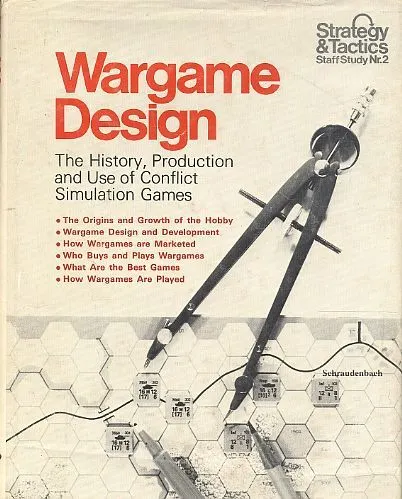
Wargame Design is a board game released in 1977 ages 12 and up. It was designed by Jim Dunnigan, Richard H. Berg, Redmond Aksel Simonsen, Stephen B. Patrick, and David C. Isby and its main mechanics are Simulation.






"The History, Production and Use of Conflict Simulation Games", Strategy & Tactics Staff Study Nr. 2. Co-authored by "the staff of Strategy & Tactics Magazine" with articles specifically credited to Stephen B. Patrick, Richard H. Berg, Redmond A. Simonsen, David C. Isby and James F. Dunnigan. The chapters include The History of Wargaming (Patrick), Game Design and Development: A Case Study (Panzergruppe Guderian, Berg), Image and System: Graphics and Physical Systems Design (Simonsen), Notes on Game Design (Patrick), Research (Isby), The Business of Wargaming: The Economic Realities of Wargame Manufacturing (Dunnigan), Wargame Directory and a Suggested Library of Games (Berg) and Symbols, Terms and Format (Simonsen). 186 page hardbound book with dust jacket, black and white illustrations. Reprinted in a trade paperback edition.
The catalogue lists Wargame Design for ages 12 and up. This is the publisher’s recommendation and reflects reading demands, rule complexity and small components rather than theme alone. Younger players can often join with help from an adult, so check the age guidance on your edition and consider your group’s experience with board games.
Wargame Design has a complexity rating of 2.3 out of 5 from BoardGameGeek players, which makes it a medium-light game. The rating reflects how much rules knowledge, planning and decision-making a typical game demands. Expect a longer first teach for heavier games, and use a preparation guide before game night.
Wargame Design belongs to these categories: Wargame and Book. Its main mechanics are Simulation. Categories describe the theme and setting of a game, while mechanics describe what players actually do on their turns. Each mechanic links to a catalogue hub with similar games, which helps when you want something comparable.
The credited designers of Wargame Design are: Jim Dunnigan, Richard H. Berg, Redmond Aksel Simonsen, Stephen B. Patrick, and David C. Isby. These credits come from the published game data and name the people responsible for the game’s design, not its illustrators or publishers. Designer pages on MeepleRules collect other titles by the same designers, which helps when you enjoy a game and want to find similar ones.
The catalogue lists Wargame Design as a base game. It can be played on its own with the components in the box and does not require any other title. Expansions, if any exist, add new content or rules on top of it and are listed separately in the catalogue with a link back to this base game.