

- BGG-Rang
- BGG #2.432
- BGG-Bewertung
- 7,6
A Victory Lost: Crisis in Ukraine 1942-1943
- 2 Spieler
- 360 Min.
- Komplexität 2,6/5
- 2006
2017
Regelhilfe für Operation Mercury: The Invasion of Crete
Verständliche Erklärungen zu Spielzügen, Karteneffekten und strittigen Situationen mit Verweisen auf offizielle Quellen und gespeichertem Fragenverlauf.
Für 2 Personen
Was möchtest du wissen?
Antworten stammen aus dem offiziellen Regelheft, mit Seitenangabe zum Nachprüfen.
Operation Mercury: The Invasion of Crete ist ein Brettspiel aus dem Jahr 2017 für 2 Personen und mit 60–1710 Minuten pro Partie. Entwickelt wurde es von Joe Chacon; die wichtigsten Mechaniken sind Dice Rolling, Hexagon Grid und Simulation.




Auf Englisch
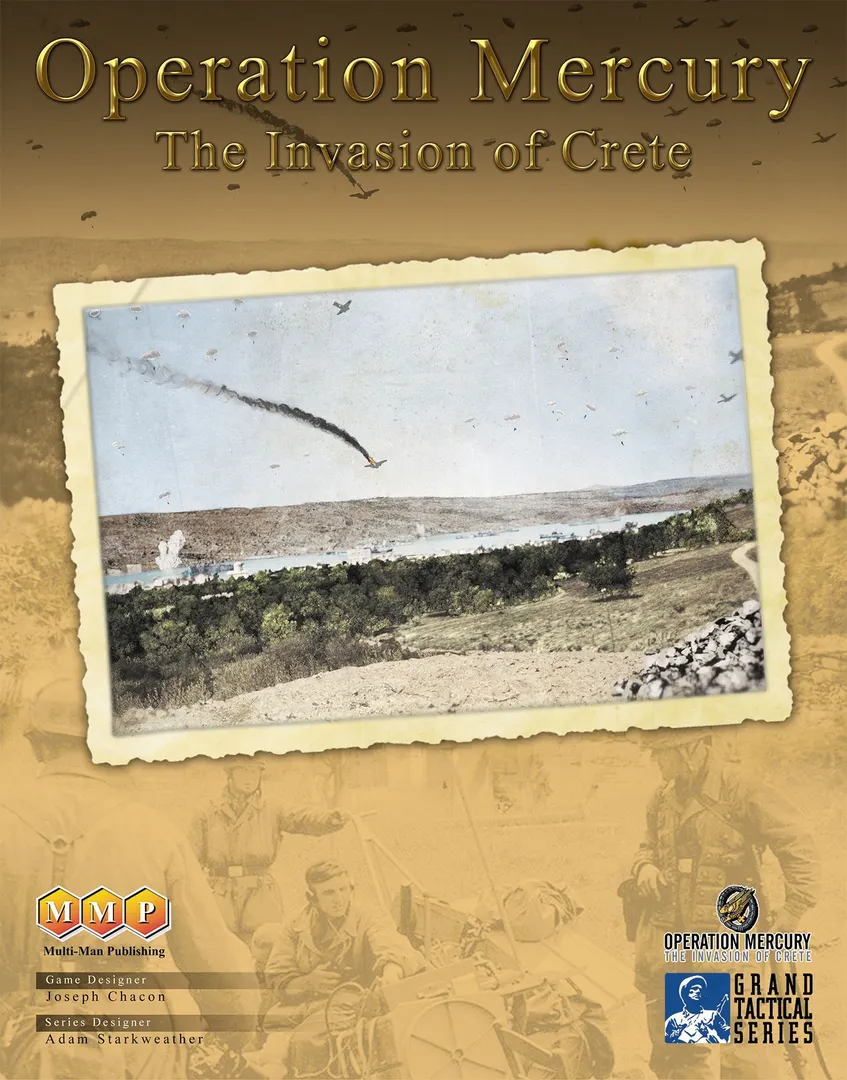
Early in the morning on 20 May 1941, as 30,000 Commonwealth soldiers on Crete were finishing breakfast, hundreds of German transport aircraft—some towing gliders—rumbled over the Mediterranean island. The air above was suddenly filled with parachutes as thousands of elite German paratroops—Fallschirmjäger—descended from the sky. The invasion of Crete was one of the most dramatic battles of the Second World War. Over a nine-day period in May 1941, a mixed force of Commonwealth and Greek troops desperately tried to fight off the German assault. Despite appalling casualties, the paratroopers and glider-borne troops managed to secure a foothold and the critical Maleme Airfield to open the door for the German Gebirgsjäger (mountain troops) to land under fire. Together the Fallschirmjäger and Gebirgsjäger pushed the Commonwealth troops to their breaking point and forced a deadly battle of delay and pursuit. This was a true soldier’s battle, with both sides in desperate situations often lacking higher-level control and support. The Germans had to quickly secure a usable airfield or face the annihilation of their entire airborne force. The Commonwealth needed to crush the German landings or—failing that—evacuate the bulk of its forces to continue the fight in North Africa and Syria. The German invasion of Crete in May 1941 stands as a landmark in the history of airborne warfare. Up until that point, airborne operations were tactical operations to seize key objectives in advance of the ground forces. The German invasion of Crete (codenamed Operation Merkur) was the first strategic airborne operation. Although casualties would mean Crete was the last hurrah for the German airborne in a major air assault, it set the stage for even larger future Allied airborne operations in the Mediterranean, Western Europe, and Asia. Operation Mercury maintains the same level of detail and scale as other Grand Tactical Series (GTS) games. Players command divisions and maneuver company-sized units to fight one of the most desperate battles of the war. Using the GTS 2.0 rules, Operation Mercury offers two players or teams a wide range of scenarios ranging from a single small map with a few units on each side to the full battle including up to two German divisions and several Commonwealth and Greek brigades. Operation Mercury covers all the major airdrops and fighting across the island from Heraklion in the east, through Rethymnon, and from Maleme to Suda Bay then south to the Askifou Plain, scene of the last major fight during the withdrawal. As the Commander of Allied forces on Crete, can you deny the Germans a precious airfield and negate their much-needed air-landing reinforcements for a quick victory? Of all operations of war, a withdrawal under heavy enemy pressure is probably the most difficult and perilous. Can you get the bulk of your forces to the southern evacuation ports? As the German, how quickly can you force the collapse of the Commonwealth morale and trigger their withdrawal? Features include: Shifting Allied morale state based on relative casualties and key events, which can trigger evacuation and end-game victory conditions. Random events, including tank breakdowns, misdirected airstrikes, and partisan attacks. An option for Commonwealth naval support at the risk of losing precious ships to German air attacks. Thirteen scenarios include: Separate one-map battles for the airdrops at Rethymnon, Heraklion, and the Maleme/Canea sector. A one-map battle for the New Zealand counter-attack to retake Maleme airfield. One-, two-, and three-map battles for the difficult German advance and Commonwealth delay and withdrawal. The full campaign on all five maps or just the main event from Maleme to Askifou Plain on three maps. Hypothetical German precision drops as well as a German free drop scenario. OPERATION MERCURY includes: Grand Tactical Series Rulebook 2.0 (36 pages, color) Operation Mercury Exclusive Rules (56 pages, color) Rules Summary (16 pages, B&W) Operation Mercury TRC/TEC set (2 cards, color) Operation Mercury Divisional Charts set (4 cards, color) Operation Mercury Off-Map Display (1 card, color) Five 22” x 34” maps Two 17” x 22” maps Two 8-1/2” x 11” maps Eight countersheets (5/8”) Four 10-sided dice One 3” box & lid (from the publisher's website)
Laut Katalog unterstützt Operation Mercury: The Invasion of Crete 2 Personen. Das ist die vom Verlag angegebene Spielerzahl, das Spiel ist also genau für diese Anzahl von Mitspielenden ausgelegt. Varianten für andere Gruppengrößen sind, sofern vorhanden, in der Anleitung deiner Ausgabe beschrieben; prüfe sie, bevor du eine andere Konfiguration aufbaust.
Die angegebene Spieldauer für Operation Mercury: The Invasion of Crete beträgt 60–1710 Minuten. Das ist die Schätzung des Verlags für eine vollständige Partie. Die tatsächliche Dauer hängt von der Gruppe, der Personenzahl und der Regelkenntnis ab: Erste Partien dauern meist länger, erfahrene Gruppen sind oft schneller fertig. Aufbau und Regelerklärung sind in dieser Schätzung nicht enthalten.
Operation Mercury: The Invasion of Crete hat bei BoardGameGeek eine Komplexitätswertung von 3,9 von 5 und gilt damit als schweres Spiel. Die Wertung zeigt, wie viel Regelwissen, Planung und Entscheidungen eine typische Partie verlangt. Schwerere Spiele brauchen bei der ersten Erklärung mehr Zeit, daher hilft vor dem Spieleabend eine Vorbereitungsanleitung.
Operation Mercury: The Invasion of Crete gehört zu diesen Kategorien: Wargame und World War II. Die wichtigsten Mechaniken sind Dice Rolling, Hexagon Grid und Simulation. Kategorien beschreiben Thema und Setting eines Spiels, Mechaniken dagegen, was die Spielenden in ihrem Zug tatsächlich tun. Jede Mechanik führt zu einer Katalogseite mit ähnlichen Spielen, falls du etwas Vergleichbares suchst.
Als Autoren von Operation Mercury: The Invasion of Crete sind angegeben: Joe Chacon. Diese Angaben stammen aus den veröffentlichten Spieldaten und nennen die für das Spieldesign verantwortlichen Personen, nicht die Illustratoren oder Verlage. Die Autorenseiten auf MeepleRules sammeln weitere Titel derselben Autoren – praktisch, wenn dir ein Spiel gefällt und du ähnliche Spiele suchst.
Im Katalog ist Operation Mercury: The Invasion of Crete als Grundspiel aufgeführt. Es lässt sich eigenständig mit dem Material aus der Schachtel spielen und benötigt keinen weiteren Titel. Erweiterungen, sofern es welche gibt, ergänzen neues Material oder neue Regeln und sind im Katalog separat mit einem Verweis auf dieses Grundspiel aufgeführt.