
- BGG rank
- BGG #10,789
- BGG rating
- 7.7
Balance of Powers
- 2–7 players
- 120–1440 min
- Complexity 3.4/5
- 2015
2016
Rules assistance for Red Poppies Campaigns: The Battles for Ypres
Plain-language explanations of turns, card effects and disputed situations, with official source references and saved question history.
For 2 players
What would you like to know?
Answers come from the official rulebook, with the page to check.
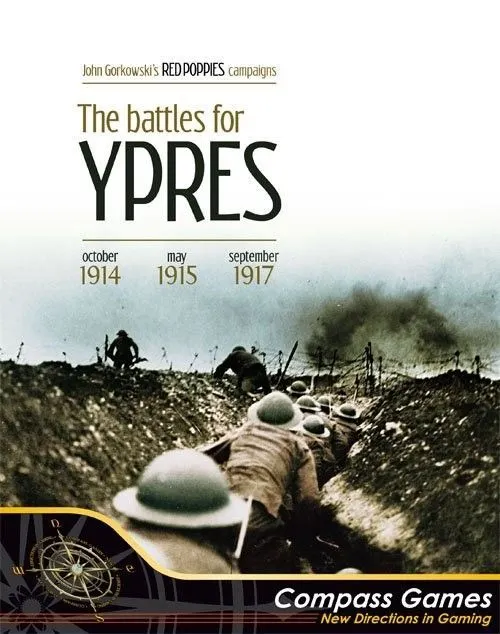
Red Poppies Campaigns: The Battles for Ypres is a board game released in 2016 for 2 players and 120–1440 minutes per game. It was designed by John Gorkowski and its main mechanics are Dice Rolling and Hexagon Grid.
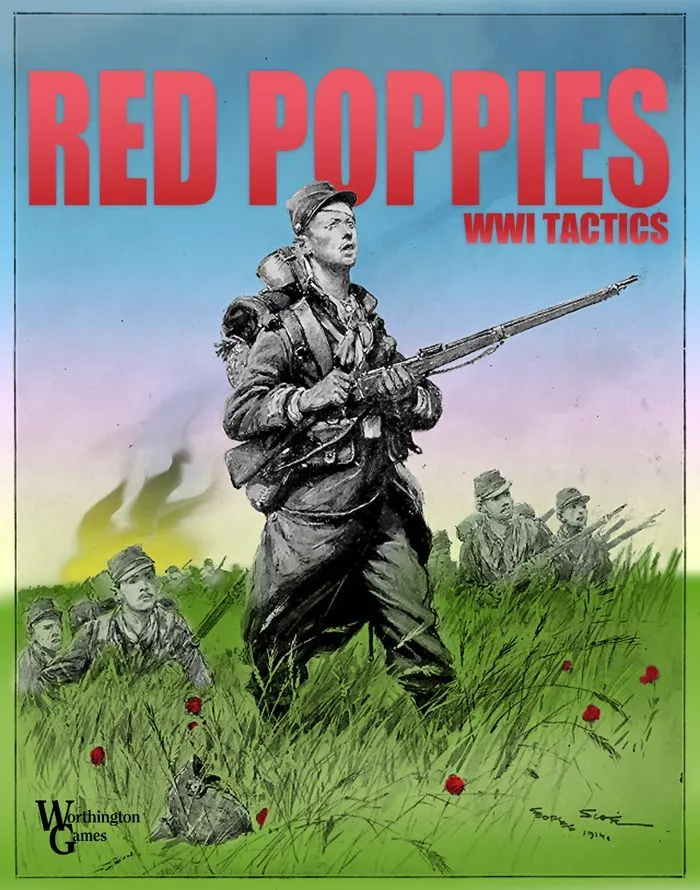

Red Poppies Campaigns (RPC) enables players to game WWI battles from the perspective of battalion and regimental command posts. Players unleash opening bombardments and then maneuver infantry companies against machine gun fire to fight battles on historically accurate maps of actual battlefields. The streamlined system for fire and movement enables a rapid ebb and flow with minimal dice rolling and lots of historical chrome. Generally speaking, units can move or fire once per turn – machine gun fire is the notable, unpredictable exception – and can initiate melee after a move. Fire resolution requires only one dice roll, made by the target and modified for the relevant circumstances such as incoming firepower, terrain, visibility, etc. Throughout, players must effectively manage the dynamic tension between top down control and bottom up initiative to get their units onto the objective before their ever-eroding control crumbles to nil. A tragic irony of WWI unifies all aspects of game play. For most of the war, effective command and control of tactical units required a degree of concentration which threatened their survival. In other words, the game illustrates the inverse relationship between a unit’s responsiveness to orders and its durability. So players must “form” infantry units to get them moving and then “disperse” them at the right moment to hold the ground gained. Enemy fire can force premature dispersion which must be remedied to get an attack moving again. For infantry, the formed condition represents troops arrayed for the convenience of top down command such as those deployed in skirmish line or a column-of-march while the dispersed condition represents troops spread out and hunkered down for their own survival. The game illustrates the evolution of tactics during WWI. In time, gas wafts across the battlefield, unit statistics change to show better performance while dispersed, a new method of tactical command and control (the “blob”) emerges, mortars pop up like mushrooms after the rain, and artillery becomes more responsive. In addition to short, standalone scenarios, RPC has a “campaign” mechanism so players can link a series of interdependent scenarios to simulate battles that spanned days, and nights. During these campaigns, the results of one scenario affect the start of another so conservation of force, supply lines, and replacements all become issues. Players will get a sense of slogging forward in yards per day - at great cost – as they plot days of grinding combat. Product Information Complexity: 6 out of 10 Solitaire suitability: 8 out of 10 Time Scale: 10 minutes per turn Map Scale: 200 yards per hex Unit Scale: Companies, squadrons, sections
Red Poppies Campaigns: The Battles for Ypres supports 2 players according to the catalogue. This is the publisher’s listed player count, so the game is designed for exactly that number of participants. Variants for other group sizes, if any, are described in the rulebook of your edition, so check it before setting up a different configuration.
The listed playing time for Red Poppies Campaigns: The Battles for Ypres is 120–1440 minutes. This is the publisher’s estimate for a full game. The actual duration depends on the group, the player count and familiarity with the rules: first sessions usually run longer, while experienced groups often finish faster. Setup and teaching time are not included in this estimate.
Red Poppies Campaigns: The Battles for Ypres has a complexity rating of 2.9 out of 5 from BoardGameGeek players, which makes it a medium-light game. The rating reflects how much rules knowledge, planning and decision-making a typical game demands. Expect a longer first teach for heavier games, and use a preparation guide before game night.
Red Poppies Campaigns: The Battles for Ypres belongs to these categories: Wargame and World War I. Its main mechanics are Dice Rolling and Hexagon Grid. Categories describe the theme and setting of a game, while mechanics describe what players actually do on their turns. Each mechanic links to a catalogue hub with similar games, which helps when you want something comparable.
The credited designers of Red Poppies Campaigns: The Battles for Ypres are: John Gorkowski. These credits come from the published game data and name the people responsible for the game’s design, not its illustrators or publishers. Designer pages on MeepleRules collect other titles by the same designers, which helps when you enjoy a game and want to find similar ones.
The catalogue lists Red Poppies Campaigns: The Battles for Ypres as a base game. It can be played on its own with the components in the box and does not require any other title. Expansions, if any exist, add new content or rules on top of it and are listed separately in the catalogue with a link back to this base game.