

- BGG rank
- BGG #6,585
- BGG rating
- 7.4
Hybrid
2 players120 min2003
Complexity 3.2/5
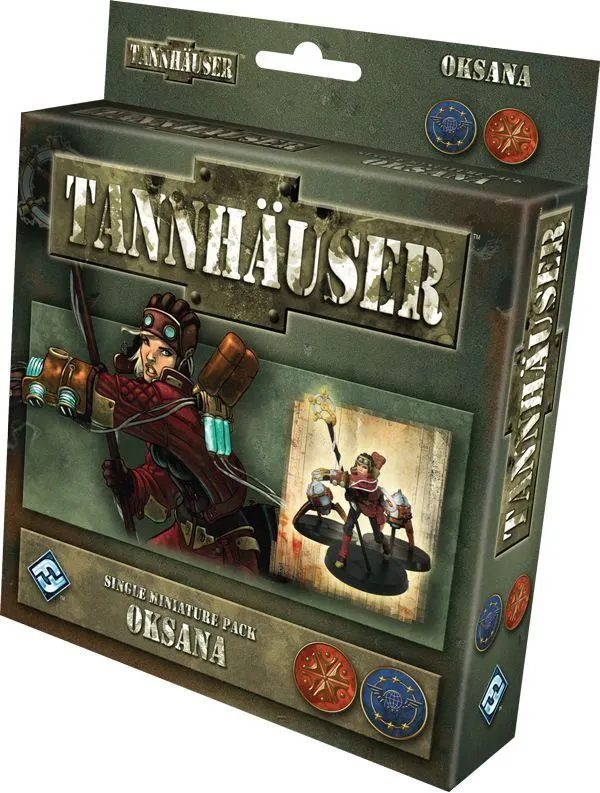
Rules assistance for Tannhäuser: Oksana
Plain-language explanations of turns, card effects and disputed situations, with saved question history.
What would you like to know?
Answers come from the official rulebook, with the page to check.
Tannhäuser: Oksana is an expansion for Tannhäuser released in 2011 for 2–10 players, 60 minutes per game, and ages 12 and up. It was designed by William Grosselin and Didier Poli and its main mechanics are Dice Rolling.
2 players120 min2003
3–6 players60 min2006
1–4 players2019
2 players45–120 min2025

1–4 players30–180 min2016
2–4 players60 min2004
2–10 players120 min2004

1–2 players60 min2014
2–8 players180 min2011

2 players1943

1–2 players20–40 min2025

1–4 players30–180 min2024
From the FFG Website: "Oksana is a former Archimandrite, defeated at the hands of the reincarnated god that she refused to bow to. Now she’s back to cause a split within the Matriarchy, the powerful faction introduced in the Operation Novgorod expansion. Just as likely to side with the Union as she is with the Matriarcy on her path to vengeance, Oksana is a powerful ally or a dangerous foe, depending on where you stand in her eyes. Oksana utilizes the mechanical drones known as Voïvodes, which are utilized heavily in Operation Novgorod. These Voïvodes operate under Oksana’s control, doing her bidding without hesitation. Oksana comes complete with a detailed pre-painted figure of Oksana Gusarenko, two pre-painted Voïvode miniatures, two character sheets, and tokens for all of her equipment. Oksana has the ability to field two Voïvodes when she is chosen as a hero. Players wishing to utilize Oksana’s technological talents must replace one of their Troopers with her two Voïvodes. She cannot be used on the same team as Zor’ka from the Operation Novgorod expansion. In addition to these components, Oksana also comes with a rulebook featuring a custom scenario that sends her into Reich territory on a quest to recover lost documents."
Tannhäuser: Oksana supports 2–10 players according to the catalogue. This range comes from the publisher’s listed player count, so the game can be set up for any group size within it. Some setups, rules and scoring details may still vary by player count, so check your edition’s rulebook for the exact configuration.
The listed playing time for Tannhäuser: Oksana is 60 minutes. This is the publisher’s estimate for a full game. The actual duration depends on the group, the player count and familiarity with the rules: first sessions usually run longer, while experienced groups often finish faster. Setup and teaching time are not included in this estimate.
The catalogue lists Tannhäuser: Oksana for ages 12 and up. This is the publisher’s recommendation and reflects reading demands, rule complexity and small components rather than theme alone. Younger players can often join with help from an adult, so check the age guidance on your edition and consider your group’s experience with board games.
Tannhäuser: Oksana has a complexity rating of 1.4 out of 5 from BoardGameGeek players, which makes it a light game. The rating reflects how much rules knowledge, planning and decision-making a typical game demands. Expect a longer first teach for heavier games, and use a preparation guide before game night.
Tannhäuser: Oksana belongs to these categories: Wargame, Horror, and Miniatures. Its main mechanics are Dice Rolling. Categories describe the theme and setting of a game, while mechanics describe what players actually do on their turns. Each mechanic links to a catalogue hub with similar games, which helps when you want something comparable.
The credited designers of Tannhäuser: Oksana are: William Grosselin and Didier Poli. These credits come from the published game data and name the people responsible for the game’s design, not its illustrators or publishers. Designer pages on MeepleRules collect other titles by the same designers, which helps when you enjoy a game and want to find similar ones.
The catalogue lists Tannhäuser: Oksana as an expansion for Tannhäuser. Expansions add new content, rules or scenarios to the base game and usually cannot be played on their own, so you need Tannhäuser to use it. Check that your edition of Tannhäuser is compatible, as some expansions were revised between editions.
