
- BGG rank
- BGG #8,645
- BGG rating
- 8.0
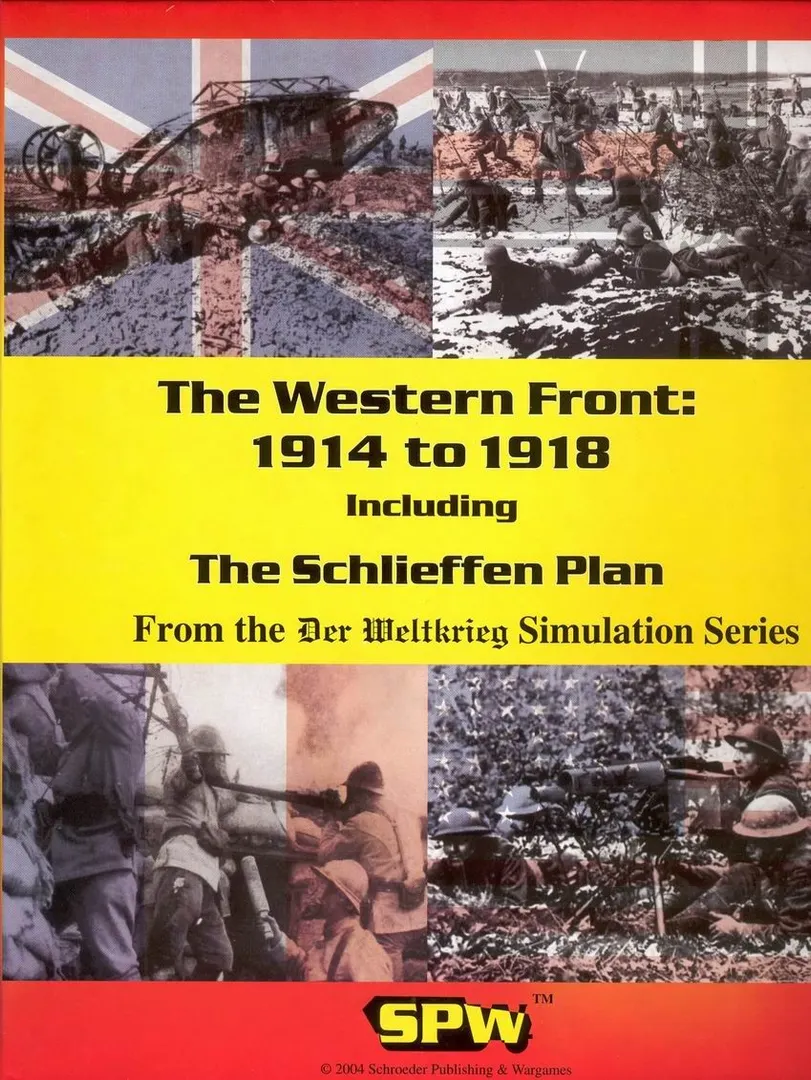
The Western Front: 1914 to 1918
- 2 players
- 360 min
- Complexity 3.4/5
- 2004
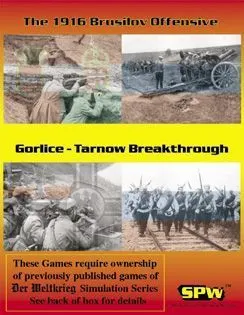
Expansion for Serbia the Defiant / Romania: Transylvanian Gambit
2001
Rules assistance for The 1916 Brusilov Offensive / Gorlice-Tarnow Breakthrough
Plain-language explanations of turns, card effects and disputed situations, with official source references and saved question history.
What would you like to know?
Answers come from the official rulebook, with the page to check.
The 1916 Brusilov Offensive / Gorlice-Tarnow Breakthrough is an expansion for Serbia the Defiant / Romania: Transylvanian Gambit released in 2001 for 2 players, 360 minutes per game, and ages 12 and up. It was designed by David Schroeder and its main mechanics are Dice Rolling, Hexagon Grid, and Simulation.
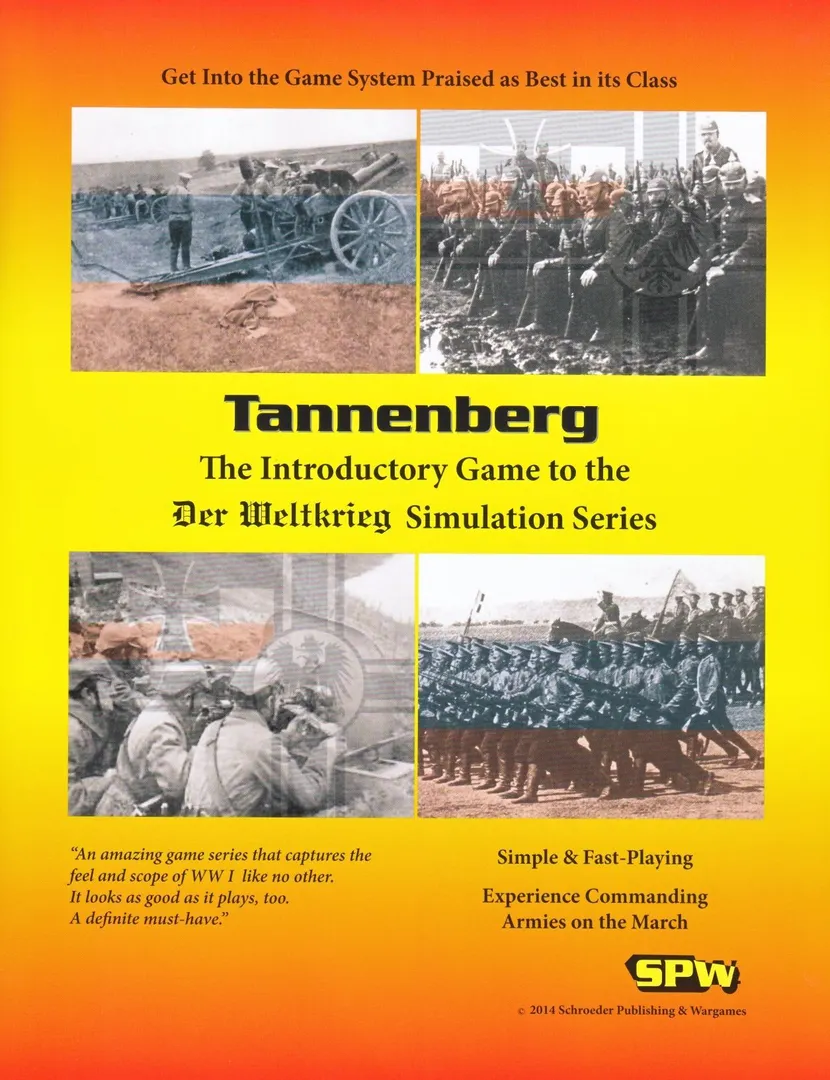


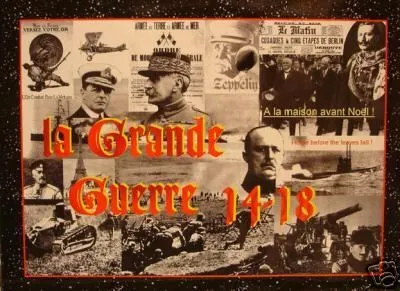
Part of David Schroeder's "Der Weltkrieg" wargame series. Gorlice-Tarnow Breakthrough: May 1915 The head of the German armies, von Falkenhayn, wants the focus of the German operations in the war to be on the western front. Yet to make this a reality, he feels that relief must first be provided to the endangered Austro-Hungarians. Recent Russian pressure had almost cracked the final Austro-Hungarian defensive lines in the Carpathians, and new pressure was being brought to bear on Germany's weak ally by the Italians, who had just entered the war. To help the Austro-Hungarians, a new German army is formed under the capable von Mackensen, and placed in the line east of Crackow. After a furious hurricane barrage, von Mackensen attacks and completely pierces the Russian lines. A Russian retreat ensues that enables the Central Powers' forces to recapture most of Galicia. Von Falkenhayn wanted to stop operations at this point and shift to the west, but pressure from the Kaiser, at the insistance of Hindenburg and Ludendorff, resulted in a widening of the offensive. Attacks were then launched in the northern sector of the eastern front as well. Enveloped on two sides, the Russians reacted with their classic response, a retreat back into Russia, leaving Russian Poland to the Germans. The Central Powers offensive wound down as they struggled to supply troops hundreds of miles past the supply heads. The offensive has saved Austria-Hungary from immediate peril, but it does not knock Russia out of the war. And instead of enabling von Falkenhayn to focus on the west, most of the newly created German forces are fed into the increasing vastness of the eastern front. The Brusilov Offensive: June 1916 In response to French pleas for help to relieve the pressure at Verdun, the Russian STAVKA authorizes a major offensive. General Brusilov plans attacks all along the front of his Southwest Army Group aiming primarily at Austro-Hungarian positions. His belief is that attacks across the width of his front will prevent the enemy from being able to quickly reinforce areas under local attack. The Austro-Hungarians are caught off-guard as their focus is a new offensive of their own in Italy. The Russian attacks achieves numerous breakthroughs in numerous sectors and many Austro-Hungarian units are completely routed. The Russians take hundreds of thousands of prisoners and advance tens of miles, recapturing significant cities. German reinforcements are rushed from the north and from Verdun. The Germans also take over command of almost the entire eastern front, and Austria-Hungary is placed in a subserviant position. The Russian offensive peters out as Brusilov's forces start to experience supply shortages, and Central Powers' resistance stiffens. Brusilov had planned on support from Russian armies to the north to pin down German forces with attacks of their own, but they failed to support him. The losses mount and, after months of fighting, the Russians finally call a halt to further attacks. The Brusilov Offensive did relieve the pressure on the French and it came very close to knocking Austria-Hungary out of the war. Had Brusilov been supported by his peers to the north, and by the Russian Allies (including the hesitant Romanians) the war might well have been won by the Entente in 1916. This game contains 2 scenarios covering the 1915 Gorlice-Tarnow offensive and the 1916 Brusilov Offensive. NOTE: This is not a stand-alone game. It requires the ownership of Tannenberg: Eagles in the East / Galicia: The Forgotten Cauldron and Serbia the Defiant / Romania: Transylvanian Gambit to play. 20km/hex 4 days/turn 560 counters (2 countersheets) 3 small maps (4-5N, 4-5E, 5-5S) Complexity = medium
The 1916 Brusilov Offensive / Gorlice-Tarnow Breakthrough supports 2 players according to the catalogue. This is the publisher’s listed player count, so the game is designed for exactly that number of participants. Variants for other group sizes, if any, are described in the rulebook of your edition, so check it before setting up a different configuration.
The listed playing time for The 1916 Brusilov Offensive / Gorlice-Tarnow Breakthrough is 360 minutes. This is the publisher’s estimate for a full game. The actual duration depends on the group, the player count and familiarity with the rules: first sessions usually run longer, while experienced groups often finish faster. Setup and teaching time are not included in this estimate.
The catalogue lists The 1916 Brusilov Offensive / Gorlice-Tarnow Breakthrough for ages 12 and up. This is the publisher’s recommendation and reflects reading demands, rule complexity and small components rather than theme alone. Younger players can often join with help from an adult, so check the age guidance on your edition and consider your group’s experience with board games.
The 1916 Brusilov Offensive / Gorlice-Tarnow Breakthrough has a complexity rating of 3.0 out of 5 from BoardGameGeek players, which makes it a medium-weight game. The rating reflects how much rules knowledge, planning and decision-making a typical game demands. Expect a longer first teach for heavier games, and use a preparation guide before game night.
The 1916 Brusilov Offensive / Gorlice-Tarnow Breakthrough belongs to these categories: Wargame, Expansion for Base-game, and World War I. Its main mechanics are Dice Rolling, Hexagon Grid, and Simulation. Categories describe the theme and setting of a game, while mechanics describe what players actually do on their turns. Each mechanic links to a catalogue hub with similar games, which helps when you want something comparable.
The credited designers of The 1916 Brusilov Offensive / Gorlice-Tarnow Breakthrough are: David Schroeder. These credits come from the published game data and name the people responsible for the game’s design, not its illustrators or publishers. Designer pages on MeepleRules collect other titles by the same designers, which helps when you enjoy a game and want to find similar ones.
The catalogue lists The 1916 Brusilov Offensive / Gorlice-Tarnow Breakthrough as an expansion for Serbia the Defiant / Romania: Transylvanian Gambit. Expansions add new content, rules or scenarios to the base game and usually cannot be played on their own, so you need Serbia the Defiant / Romania: Transylvanian Gambit to use it. Check that your edition of Serbia the Defiant / Romania: Transylvanian Gambit is compatible, as some expansions were revised between editions.