

- BGG rank
- BGG #7,576
- BGG rating
- 7.4
The Next War: Modern Conflict in Europe
- 2 players
- 360 min
- Complexity 4.2/5
- 1978
1977
Rules assistance for Fulda Gap: The First Battle of the Next War
Plain-language explanations of turns, card effects and disputed situations, with official source references and saved question history.
For 2 players
What would you like to know?
Answers come from the official rulebook, with the page to check.
Fulda Gap: The First Battle of the Next War is a board game released in 1977 for 2 players, 300 minutes per game, and ages 12 and up. It was designed by Jim Dunnigan and its main mechanics are Dice Rolling, Hexagon Grid, and Simulation.





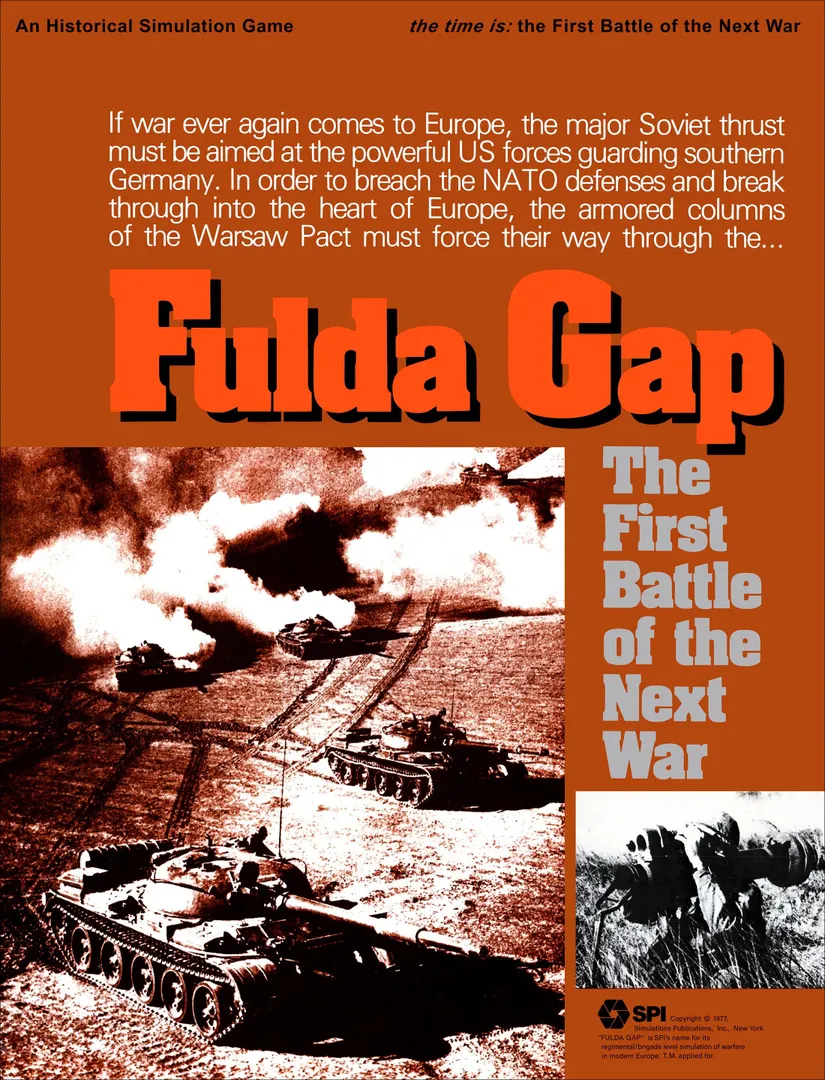
"Fulda Gap: The First Battle of the Next War", is a regimental/brigade level wargame simulation of a possible Warsaw Pact assault into West Germany through the area of relatively open terrain centered around the town of Fulda sometime in the near future. Success would allow the Pact armies to drive a wedge between the NATO forces deployed to the north and south, seize several important logistic centers, and perhaps establish a bridgehead across the Rhine River. Of all the scenarios for a coming world war, none has received more attention than the possibility of a future NATO-Warsaw Pact confrontation. For 25 years, the armies of East and West have faced one another across a divided Germany, each knowing that it is in this region that the course of any war will be decided. There are two types of games: the Standard Game and the Advanced Game. Preferably, the Players should become familiar with the Standard Garne first and then increase the level of complexity until they find a rules mix with which they are most comfortable. The key to the game lies in the combination of a unique combat system and a new untried unit procedure. Basically, each ground combat unit consists of three "steps" and an untried status. As a unit enters combat, its actual strength— which may be greater or less than its normal face-value — must be determined. Combat results are expressed in terms of "retreat points" which must be expended either by retreating and/or by taking step losses. Since the owning player controls the path and method of retreat, there is a wide range of possible outcomes from each combat situation. Fulda Gap Shows the likely impact of a great number of factors on modern warfare. Supply and movement systems stress the importance of roads and autobahns; rules are provided to reflect the importance of divisional integrity, artillery, helicopters, airmobile units, replacements, Soviet doctrine, field fortifications, and disengagement. And players wishing to increase the complexity of the game may use an innovative air system. Extensive rules also cover chemical and nuclear warfare. Game Scale: Game Turn: 1 day Hex: 3.88 miles / 6.25 kilometers Units: Regiment & Brigade Game Inventory: One 22 x 34" full color map One dual-side printed countersheet (400 1/2" counters) One 16-page Fulda Gap rulebook One dual-side printed Turn Record/Reinforcement Track Two dual-side printed Charts & Tables folder (4 pages, Combat, Terrain tables, etc) Solitaire Playability: High Complexity Level: Medium Players: 2 or more Playing Time: 4-15 hours
Fulda Gap: The First Battle of the Next War supports 2 players according to the catalogue. This is the publisher’s listed player count, so the game is designed for exactly that number of participants. Variants for other group sizes, if any, are described in the rulebook of your edition, so check it before setting up a different configuration.
The listed playing time for Fulda Gap: The First Battle of the Next War is 300 minutes. This is the publisher’s estimate for a full game. The actual duration depends on the group, the player count and familiarity with the rules: first sessions usually run longer, while experienced groups often finish faster. Setup and teaching time are not included in this estimate.
The catalogue lists Fulda Gap: The First Battle of the Next War for ages 12 and up. This is the publisher’s recommendation and reflects reading demands, rule complexity and small components rather than theme alone. Younger players can often join with help from an adult, so check the age guidance on your edition and consider your group’s experience with board games.
Fulda Gap: The First Battle of the Next War has a complexity rating of 3.2 out of 5 from BoardGameGeek players, which makes it a medium-weight game. The rating reflects how much rules knowledge, planning and decision-making a typical game demands. Expect a longer first teach for heavier games, and use a preparation guide before game night.
Fulda Gap: The First Battle of the Next War belongs to these categories: Wargame and Modern Warfare. Its main mechanics are Dice Rolling, Hexagon Grid, and Simulation. Categories describe the theme and setting of a game, while mechanics describe what players actually do on their turns. Each mechanic links to a catalogue hub with similar games, which helps when you want something comparable.
The credited designers of Fulda Gap: The First Battle of the Next War are: Jim Dunnigan. These credits come from the published game data and name the people responsible for the game’s design, not its illustrators or publishers. Designer pages on MeepleRules collect other titles by the same designers, which helps when you enjoy a game and want to find similar ones.
The catalogue lists Fulda Gap: The First Battle of the Next War as a base game. It can be played on its own with the components in the box and does not require any other title. Expansions, if any exist, add new content or rules on top of it and are listed separately in the catalogue with a link back to this base game.